A custom B2B website may cost around $30,000, $50,000, or more than $100,000, depending on what the project has to solve. The main cost drivers are strategy, information architecture, unique templates, content, CMS requirements, integrations, migration, custom functionality, and stakeholder complexity. These figures are planning profiles, not fixed website prices.
How Much Does a Custom B2B Website Cost
There is no useful single average for a custom B2B website because “website project” covers everything from a small brochure site to an enterprise platform with hundreds of pages, several markets, custom integrations, and a complex product catalog.
Clutch’s 2026 web design pricing data puts agency projects broadly between $2,000 and $100,000, with an average reported project cost of about $38,105. It also notes that most projects in its review dataset cost less than $10,000. That data is useful for understanding the size of the overall market, but it combines projects with very different scopes, so it should not be treated as a benchmark for a custom corporate B2B redesign.
VALMAX uses a narrower planning framework for corporate websites. Its current guidance places smaller, relatively straightforward corporate sites around $15,000–$30,000, many custom U.S. B2B projects around $30,000–$80,000, and enterprise builds with advanced requirements at $100,000+. These are VALMAX planning ranges based on project complexity, not universal market prices.
The useful question, then, is not whether a B2B website “should” cost $30K or $100K. It is what additional work appears between those levels and whether your business actually needs it.
What Changes Between a $30K, $50K, and $100K+ Website
The three budgets below represent different project profiles rather than packages. A real estimate can fall between them or outside them.
| Around $30K | Around $50K | $100K+ | |
| Typical project | Focused custom corporate website | Strategic B2B redesign | Enterprise or highly complex digital platform |
| Strategy | Positioning mostly established | Discovery and some repositioning or messaging work | Extensive research, positioning, multiple business units or markets |
| Information architecture | Relatively simple structure | Several products, solutions, industries, or audiences | Large, interconnected architecture across many content types |
| UX | Standard buyer journeys | Custom flows for several buyer types | Multiple roles, regions, products, permissions, or complex workflows |
| Design | Custom visual design with a controlled template set | Broader custom system, more states and page types | Large design system, advanced interactions, motion, 3D, or product experiences |
| Development | Standard custom CMS build | More flexible CMS architecture and custom components | Advanced backend logic, custom applications, complex data models |
| Integrations | Analytics, forms, basic CRM connections | CRM, marketing tools, APIs, third-party systems | Several business-critical systems, custom APIs, ERP/PIM/CRM connections |
| Content | Mostly supplied by client | Content planning and copy support | Large-scale copywriting, technical content, localization, governance |
| Migration | Limited | Planned content and SEO migration | Large content library, multilingual or high-risk migration |
| Best fit | Established company with a clear offer | Growing B2B company changing how it sells | Enterprise, multi-market, multi-product, or technically complex business |
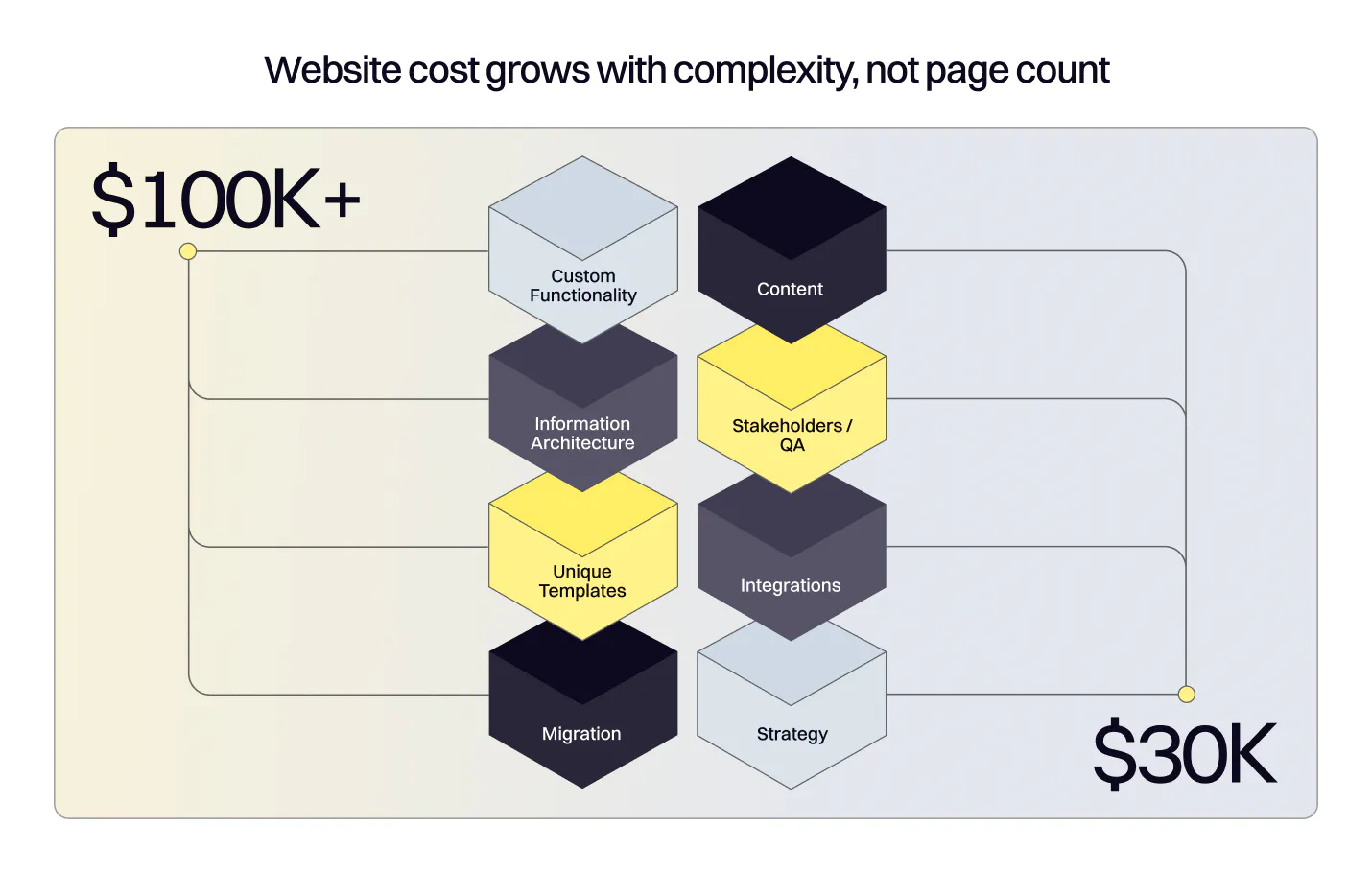
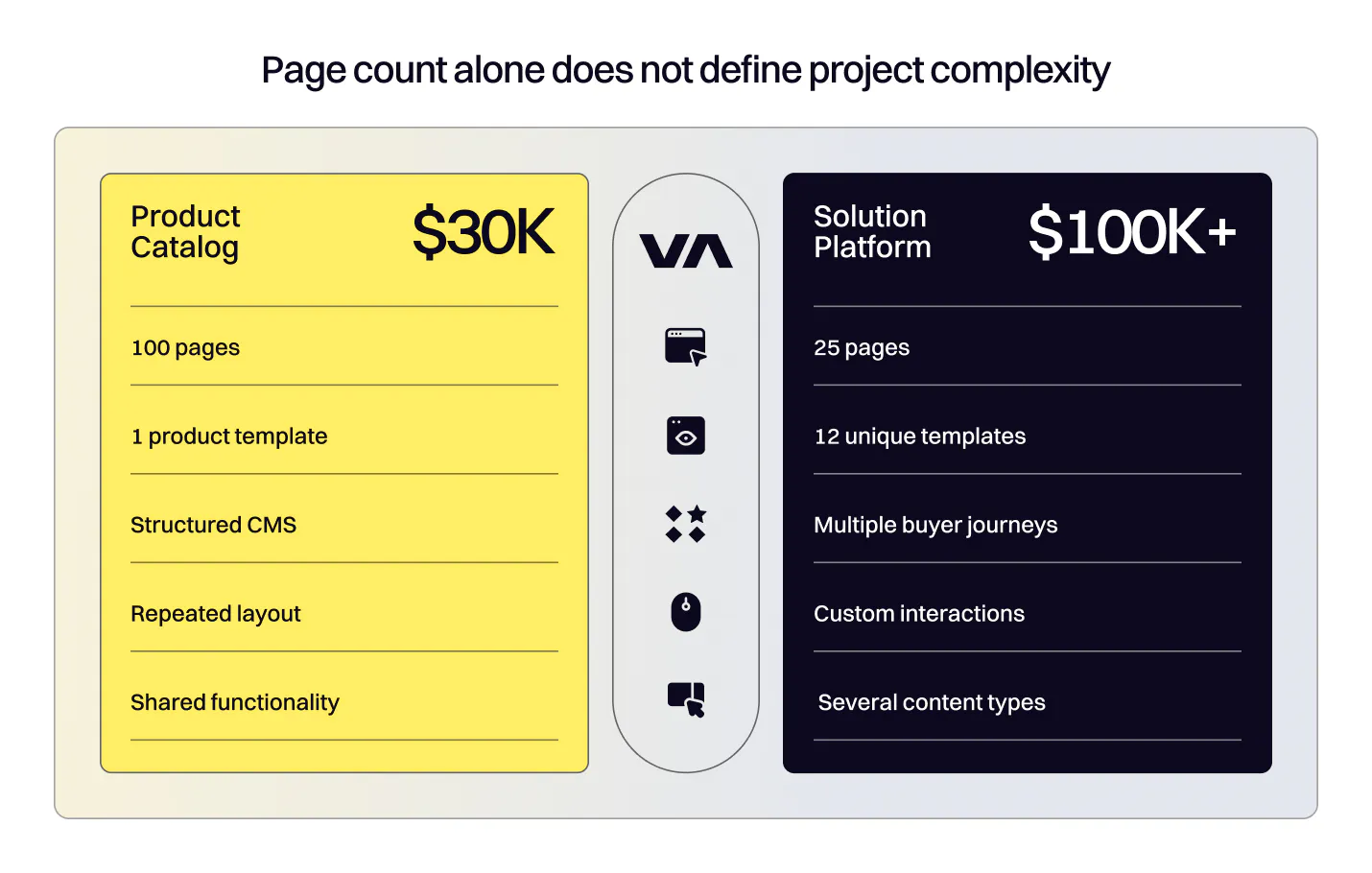
A 20-page website can therefore cost more than a 100-page website if those 20 pages require many unique layouts, custom functionality, several buyer journeys, complex integrations, and extensive strategy. That distinction is one of the most important things to understand before comparing agency estimates.
What Does a $30K B2B Website Usually Look Like
Around the $30K level, the project is usually easier to define because the business already has many of its fundamentals in place.
The company may have clear positioning, an established brand, approved messaging, and a relatively straightforward offer. The internal team can supply most of the content, and the new website does not need to reorganize hundreds of existing pages or connect several business-critical systems.
The agency’s work may include discovery, sitemap refinement, custom UX/UI, responsive design, CMS development, basic integrations, QA, and launch. The design can still be fully custom. What keeps the scope controlled is the number of unresolved business and technical questions.
A professional services company with ten to fifteen core pages is a good example. If the site has a clear Home, Services, Industries, About, Insights, Case Studies, and Contact structure, the project can focus heavily on execution rather than spending months defining how the company should organize its offer.
That is different from a company that comes to the redesign saying, “We sell five products, twelve services, three solution groups, and operate in six industries, but we are not sure which of those should drive the website.”
The second company has an information architecture problem before it has a design problem.
What Changes Around the $50K Level
A project moves toward the middle of the range when the agency needs to solve more of the business logic behind the website.
Discovery becomes more substantial. The team may need to interview stakeholders, understand several buyer types, restructure the navigation, decide how Products, Services, Solutions, Industries, and Audiences relate to one another, and build a CMS that supports those relationships.
That type of work happens before polished UI screens exist. For companies in this position, VALMAX’s guide on how to structure a B2B website around products, services, solutions, industries, or audiences explains why complex information architecture should be resolved before detailed design.
A ~$50K project may also involve more content support, additional page templates, CRM integration, SEO migration, interactive elements, custom illustrations, or motion. None of those features automatically create a $50K website. The cost comes from the combined amount of work required across strategy, content, design, and development. This is also where estimating a project by page count becomes increasingly misleading.
Why Can an Enterprise B2B Website Cost $100K or More
Enterprise projects introduce complexity that is often invisible from the homepage. A website may need to support multiple markets, languages, products, business units, industries, customer roles, or regional teams. Existing content may need to be audited and migrated without damaging organic search performance. Product information may come from another system. Marketing forms may need to pass structured data into a CRM. Some content may be public while other resources require gated access.
The organization itself can add complexity too. A redesign involving marketing, sales, product, IT, security, legal, regional teams, and several executives requires more coordination and more formal approval processes than a project with one marketing lead and one CEO.
The technical scope can also expand quickly through:
- advanced product catalogs and filtering;
- custom search;
- multilingual architecture;
- ERP, PIM, CRM, or proprietary API integrations;
- complex content relationships;
- authenticated or role-based functionality;
- interactive tools or configurators;
- accessibility and security requirements;
- large-scale migration;
- custom motion, 3D, or interactive product visualization.
At this level, the website starts behaving less like a collection of marketing pages and more like a digital platform tied to the company’s wider operating system.
Does Page Count Determine Website Price
Page count affects cost, but unique templates and content logic usually tell you more about design and development effort than the raw number of URLs.
Imagine two projects:
- Website A contains 100 product pages built from one structured product template. The CMS stores fields such as name, specifications, applications, documents, and related products. Once the system is designed and developed, additional products can be added through the same model.
- Website B contains only 25 pages, but 12 of them require unique layouts, several contain custom interactions, three audiences follow different journeys, and the CMS needs several interconnected content types.
Website B may require considerably more design and engineering work despite having fewer URLs.
The AMD digital catalog is a useful real-world example. VALMAX designed the catalog around product categories, filtering, search, specifications, documentation, variations, and pricing. Products that differed only by parameters could be grouped for the buyer while remaining separate items in the backend, and an Excel import allowed the team to update inventory and pricing at scale. The project also included full data migration.
How Much Do Strategy and Information Architecture Affect the Budget
Strategy adds cost when the website project also needs to clarify how the company should present itself to the market.
A business with established positioning and approved messaging can move into UX much faster. A company entering a new market, changing its ICP, moving from product-led selling to solution-led selling, or consolidating several business units needs more work before the sitemap is stable.
Spright is one example. The Florida B2B growth marketing company came to VALMAX without established external messaging, brand, or website. The project began with interviews, research, audience work, positioning, narrative, and tone of voice before website content and design were developed. See the Spright brand and website case study
That work increases the scope, but it also prevents a common redesign problem: approving a visual direction before the company has decided what the website needs to communicate.
For a complex corporate project, the sitemap, page hierarchy, navigation, content ownership, internal links, buyer journeys, and CMS relationships should be defined before development begins.
How Much Do Content and Migration Add to Website Cost
Content is often one of the most underestimated parts of a redesign. There is a large difference between a client providing final, approved copy for every page and an agency needing to research the business, build the messaging hierarchy, write new pages, coordinate subject-matter experts, source or produce visual assets, and upload the finished content.
Migration creates a separate workload. Moving 100 existing URLs is not simply a copy-and-paste task when the new site has a different structure. The team may need to decide what should be kept, consolidated, redirected, rewritten, or removed. Metadata, images, downloadable documents, internal links, structured content, and existing rankings all need to be considered.
A large resource center makes this even more important. If a company already receives qualified organic traffic, a redesign should include an SEO migration plan rather than treating redirects and metadata as an afterthought.
Content ownership should therefore be explicit in the proposal. “Client provides content” and “agency handles content strategy, copywriting, migration, and upload” are materially different scopes.
How Do Integrations Affect Website Development Cost
An integration adds cost according to what data needs to move, how reliable the external system is, how often synchronization happens, and what should occur when something fails.
Connecting a basic contact form to HubSpot is very different from synchronizing product information with a PIM, sending regional leads into different Salesforce workflows, pulling inventory from an ERP, or supporting authenticated pricing.
VALMAX’s corporate website development services currently cover WordPress, Webflow, and Framer and list integrations with systems including HubSpot, Pipedrive, Salesforce, and Zoho. The appropriate CMS and integration approach depend on the project requirements rather than on one platform being universally “best.”
Before estimating an integration, the agency should know which system owns the data, what information needs to move in each direction, how frequently it changes, and whether the integration is business-critical. “CRM integration” alone is not enough detail for an accurate quote.
What Do Complex B2B Website Projects Look Like in Practice
CARBO shows how several cost drivers can appear in one project. The manufacturing website involved 50+ custom pages, a multilayered navigation system, dynamic cards, smart search, structured WordPress content, a technical resource library, product and industry entry paths, custom 3D, motion, and video. VALMAX’s published case lists branding, web design, WordPress development, and 3D/motion design within a six-month project. See the CARBO website case study
The important point is not that a “50-page site” belongs in a particular price bracket. CARBO’s complexity came from the combination of product architecture, technical content, custom navigation, content relationships, visual production, CMS requirements, and development.
Goldbach Group demonstrates a different type of complexity. The project involved several businesses within one holding, multiple decision-makers, shared visual rules, flexible WordPress structures, responsive design, analytics, SEO foundations, filtering, and custom sorting. A large part of the challenge came from keeping several businesses coherent without forcing them into an identical digital presence. See the Goldbach Group case study
These projects show why the most expensive part of a corporate website is often the number of relationships the system needs to handle, not the number of pages visible in the navigation.
What Can You Phase If Your Website Budget Is Limited
If the desired scope exceeds the approved budget, reduce or phase it rather than pretending the same project can be delivered for materially less.
A first phase can prioritize the elements that affect launch and the main buying journey:
- positioning where necessary
- core information architecture
- high-value pages
- essential CMS structures
- development
- migration
- analytics
- and critical integrations
A second phase may add:
- lower-priority industry pages
- advanced motion
- interactive tools
- additional integrations
- secondary resource sections
- or broader content production
The correct split depends on the business. An ERP integration may be optional for one company and essential for another. Custom motion may differentiate a technology product but be unnecessary for a professional services firm.
If you are still defining the investment, VALMAX’s guide on whether to include your budget in a website design brief explains how to use a budget range without turning it into the agency’s automatic price.
How Can You Tell If a Website Estimate Is Reasonable
A useful estimate explains what is being priced. Comparing two proposals by their totals alone is unreliable when one includes discovery, information architecture, content migration, SEO, QA, and post-launch support while another includes only visual design and development.
Before comparing prices, check:
- what happens during discovery;
- how many unique templates and responsive states are included;
- who owns copywriting and content upload;
- what functionality is custom;
- which integrations are included;
- what content is being migrated;
- whether SEO migration is included;
- what QA and accessibility work is covered;
- how many review rounds are planned;
- what happens after launch;
- which assumptions or third-party costs are excluded.
VALMAX’s corporate website agency evaluation checklist goes deeper into comparing agency proposals and scopes.
A higher estimate is not automatically better. A lower estimate is not automatically more efficient. The useful comparison is whether each proposal solves the same problem and includes the same responsibilities.
How VALMAX Approaches B2B Website Scope and Pricing
VALMAX is a US-based web design agency working with B2B companies on strategy, branding, UX/UI, corporate website development, integrations, SEO, and post-launch support.
The estimate starts with requirements rather than a predefined package. VALMAX’s current corporate development process covers discovery, wireframing and design, development, QA, launch, and ongoing support. The agency also states that clients do not need to arrive with a complete technical specification; the team can gather requirements, research the market, and recommend the site structure.
That matters because an accurate price depends on decisions that may not exist in the initial brief. The number of pages matters, but so do the number of unique templates, content responsibility, integrations, CMS architecture, migration, functionality, timelines, and design requirements.
For complex B2B projects, VALMAX also connects the website with broader business needs through its B2B corporate website design and development solution, which covers website structure, lead-generation UX, analytics, CRM, search visibility, and ongoing digital support.
The useful outcome of an estimation conversation should be more than a number. You should understand what is included, what drives the cost, what could be phased, and which assumptions could change the estimate later.
Key Takeaways
- $30K, $50K, and $100K+ are useful complexity markers, not fixed website packages. The actual price depends on the business problem and scope.
- Page count alone is a weak pricing metric. Unique templates, content models, buyer journeys, custom functionality, and integrations often create more work than the raw number of URLs.
- Around $30K, the company usually brings more of the foundation with it. Positioning is clear, content is largely prepared, architecture is controlled, and technical requirements are relatively straightforward.
- Around $50K, the agency is often solving more strategic and structural questions. Discovery, information architecture, multiple audiences, content support, integrations, migration, and custom UX begin to expand the project.
- $100K+ projects usually combine several forms of enterprise complexity. Multiple markets, large catalogs, advanced integrations, multilingual content, custom functionality, extensive migration, and stakeholder management can all contribute.
- Content and migration need their own budget. Copywriting, technical content, asset production, redirects, content cleanup, and upload can represent substantial work.
- Integrations should be estimated from actual data flows. “HubSpot integration” or “ERP integration” is too vague to price accurately.
- If the scope exceeds the budget, phase the project. Removing lower-priority work is more credible than asking an agency to deliver the same scope for a materially lower price.
GET A TEAM THAT’S ALWAYS ON YOUR SIDE
Retainer Contract gives you reliable support whenever you need it
rate this article
5 / 5.0

based on 1 reviews