In most cases, yes. Include a realistic budget range and explain what it should cover. This helps agencies assess project fit, recommend a suitable scope, and identify what could be phased later. The budget should guide the proposal, not determine the price by itself.
Should You Tell a Web Design Agency Your Budget
A website budget gives the agency context that page count and a feature list cannot provide on their own. Two companies may both request a 30-page corporate website while requiring very different amounts of strategy, content, UX, development, migration, and technical work.
One company may already have approved positioning, copy, photography, analytics, and a straightforward WordPress setup. Another may need the agency to rethink its information architecture, write new content, migrate hundreds of resources, preserve existing search visibility, integrate a CRM, introduce several language versions, and coordinate approvals across multiple departments. The difference affects the amount of work involved, so page count alone is not enough to estimate the project.
Clutch’s current project brief guidance includes budget among the core pieces of information agencies need from a client. It recommends sharing a range even when the exact figure is not available. This helps providers decide whether the project fits their pricing and whether the scope should be phased. Clutch also lists hiding the budget as a common reason clients receive poorly matched pitches.
Sharing the budget does not tell the agency what to charge. It gives the team context to recommend a solution the business can realistically consider.
Why Does the Budget Matter Before the Agency Creates an Estimate
Custom website projects contain many variables that are difficult to price from a short feature list.
Before an agency can define the work, it may need to understand:
- the existing site and business positioning;
- target audiences and content volume;
- CMS requirements and integrations;
- SEO migration and accessibility requirements;
- visual production, analytics, and the internal approval process.
Budget is one of the constraints the agency considers alongside scope and timing.
For example, one redesign might focus on restructuring and rebuilding the company’s highest-value pages. Another could include a complete content rewrite, custom interactive features, motion design, multilingual architecture, CRM integration, and migration of a large resource center. Both approaches may address a real business need, but they involve different amounts of work and investment.
The agency needs enough commercial context to decide which approach to include in the proposal.
Clutch’s 2026 pricing data illustrates the range of web design costs: projects in its data run from roughly $2,000 to $100,000. Project size, design complexity, functionality, agency location, and scope all affect the price. Its dataset covers more than 79,000 web design agencies and thousands of first-party client reviews.
That range is too broad to use as a price list. It shows why “How much does a website cost?” cannot be answered accurately before the project is defined.
Should You Give an Exact Number or a Budget Range
A range is usually more useful.
It gives the agency enough information to plan a realistic approach without implying that every proposal should automatically reach the maximum figure.
A brief might say:
We expect to invest $35,000–$50,000 in the initial website redesign, including discovery, UX/UI design, development, migration, and launch. If an important requirement would take the project beyond this range, please price it separately.
This tells the agency what has been approved and leaves room for a conversation about scope.
An exact maximum is more appropriate when the budget is a genuine procurement constraint:
The approved project budget cannot exceed $45,000. Please recommend the strongest launch scope within that amount and separate any features you would suggest for a later phase.
These two statements mean different things.
The first provides a planning range. The second establishes a hard ceiling. Making that distinction helps agencies produce a proposal that can actually move through internal approval.
Will an Agency Charge More If You Tell Them Your Budget
This is the most common argument for keeping the budget private.
A company may worry that saying it can invest $50,000 will turn a $35,000 project into a $50,000 proposal.
The better protection is not secrecy. It is a clear scope and a transparent estimate.
Ask the agency to show what the price includes, which assumptions were used, what the client is expected to provide, which third-party expenses are excluded, and which features are optional. Where useful, ask for separate prices for additional functionality.
This makes it possible to evaluate how the agency intends to use the budget.
One team may recommend putting more of the investment into research and content. Another may simplify the first release and reserve part of the budget for later optimization. Another may identify a technical dependency that changes the scope completely.
Those differences are valuable because they reveal how each agency thinks.
When the budget is hidden, agencies still make financial assumptions. The difference is that those assumptions may have nothing to do with what the company can actually approve.
What Should a Website Design Budget Cover
A budget is useful only when the agency understands what sits inside it.
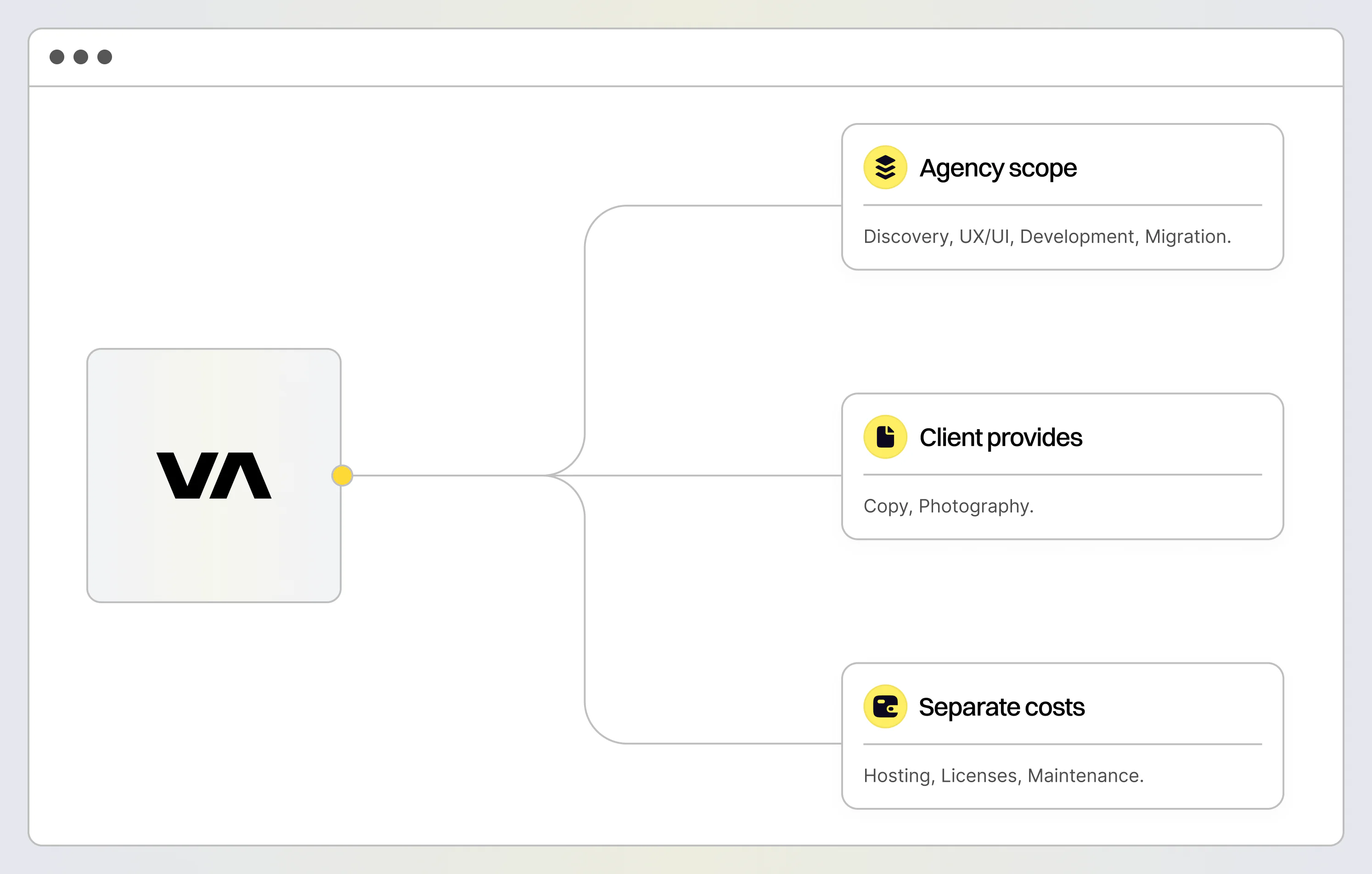
Corporate website projects can involve discovery, information architecture, UX/UI design, copywriting, development, CMS configuration, integrations, migration, SEO work, analytics, QA, motion, photography, translation, training, and post-launch maintenance.
Not every project needs all of these services.
The brief should simply make responsibility clear.
| Budget statement | What the agency understands |
| Budget: $40,000 | The financial limit is visible, but the expected scope is still unclear |
| $30,000–$40,000 for UX/UI and development; content supplied internally | The agency knows both the range and content responsibility |
| Up to $60,000 including strategy, copy, design, development, and migration | The agency can scope an end-to-end project against a fixed ceiling |
| Budget not approved; provide a core and recommended option | The agency knows that estimating the right level of investment is part of the task |
| Target: $50,000, with additional budget possible for justified integrations | The base scope and areas of flexibility are clear |
This is more useful than adding a budget field to a brief without explaining what the figure represents.
What If You Do Not Know Your Website Budget
Do not invent one.
A company commissioning its first custom corporate website may have no useful internal benchmark. Even companies that redesigned a site five years ago may now be buying a very different project because the business, content, systems, and expectations have changed.
If no budget has been approved, tell the agency that directly and describe the requirements as accurately as possible.
For example: We have not finalized the budget yet. We need a B2B corporate website covering discovery, information architecture, approximately 8–10 main page templates, custom UX/UI design, WordPress development, HubSpot integration, content migration, and SEO migration. Please recommend an appropriate scope and identify the requirements that have the greatest impact on cost.
That gives the agency something it can evaluate.
Another useful approach is to request two scopes: a core launch and a recommended version. Optional functionality can then be estimated separately.
This is particularly useful when the company is deciding whether features such as advanced search, custom animation, multilingual support, interactive tools, or complex integrations need to be included at launch.
How Do You Decide on a Realistic Website Budget
Start with the problem the website needs to solve.
A simple visual refresh and a strategic B2B redesign may both involve “web design,” but the second project can include substantially more work before visual design even begins.
Consider whether the company needs to change positioning or messaging, restructure its services, create new content, migrate existing pages, integrate other systems, protect existing SEO performance, introduce new markets or languages, or build functionality that does not exist on the current site.
Those decisions affect the investment more than an arbitrary page count.
It is also useful to speak with a small number of agencies whose work matches the project. Early conversations can help establish whether the expected scope and available investment are compatible before the company enters a formal selection process.
For context, VALMAX currently publishes planning ranges of approximately $15,000–$30,000 for smaller corporate sites with limited customization, $30,000–$80,000 for many custom U.S. B2B projects, and $100,000+ for enterprise projects involving requirements such as multilingual content or advanced integrations. These are VALMAX’s own planning ranges, not universal industry pricing.
That distinction is important. A useful budget is specific to the company’s project, not an average copied from another website.
What If the Scope Is Larger Than the Budget
Then the scope needs to change.
A credible agency should be able to explain which requirements are essential to the first release and which can be deferred without undermining the project.
Suppose the company wants a repositioning, full content rewrite, new identity, multilingual corporate site, CRM integration, custom 3D, several interactive tools, and migration of hundreds of pages. If the approved investment cannot support all of that work properly, keeping every requirement in the proposal does not make the project cheaper. It creates unrealistic expectations.
Phasing is often a better solution.
The first release might include the new positioning, core architecture, main conversion pages, development, and migration. Secondary integrations or advanced visual features can follow once the core site is live.
The right prioritization depends on business value. A feature that directly affects a major buyer journey deserves different treatment from a visual idea that would simply be nice to have.
Budget constraints become useful when they force the client and agency to make those priorities explicit.
What Information Should You Include With the Budget
The budget should sit beside enough context for an agency to interpret it correctly.
A good brief explains why the project is happening, what is not working today, what business outcome the company wants to improve, who uses the website, what the agency is expected to deliver, when the site needs to launch, and which technical requirements are already known.
The client does not need to solve the project before asking for help.
In fact, an agency may be better positioned to recommend the sitemap, CMS, page hierarchy, or technical approach after discovery.
Clutch describes a project brief as a starting point rather than a complete specification and recommends giving providers enough information to understand the objective, required help, company context, constraints, and budget.
That is a useful standard for website projects as well.
How Should You Compare Proposals After Sharing Your Budget
Compare the scope behind the number, not only the final price.
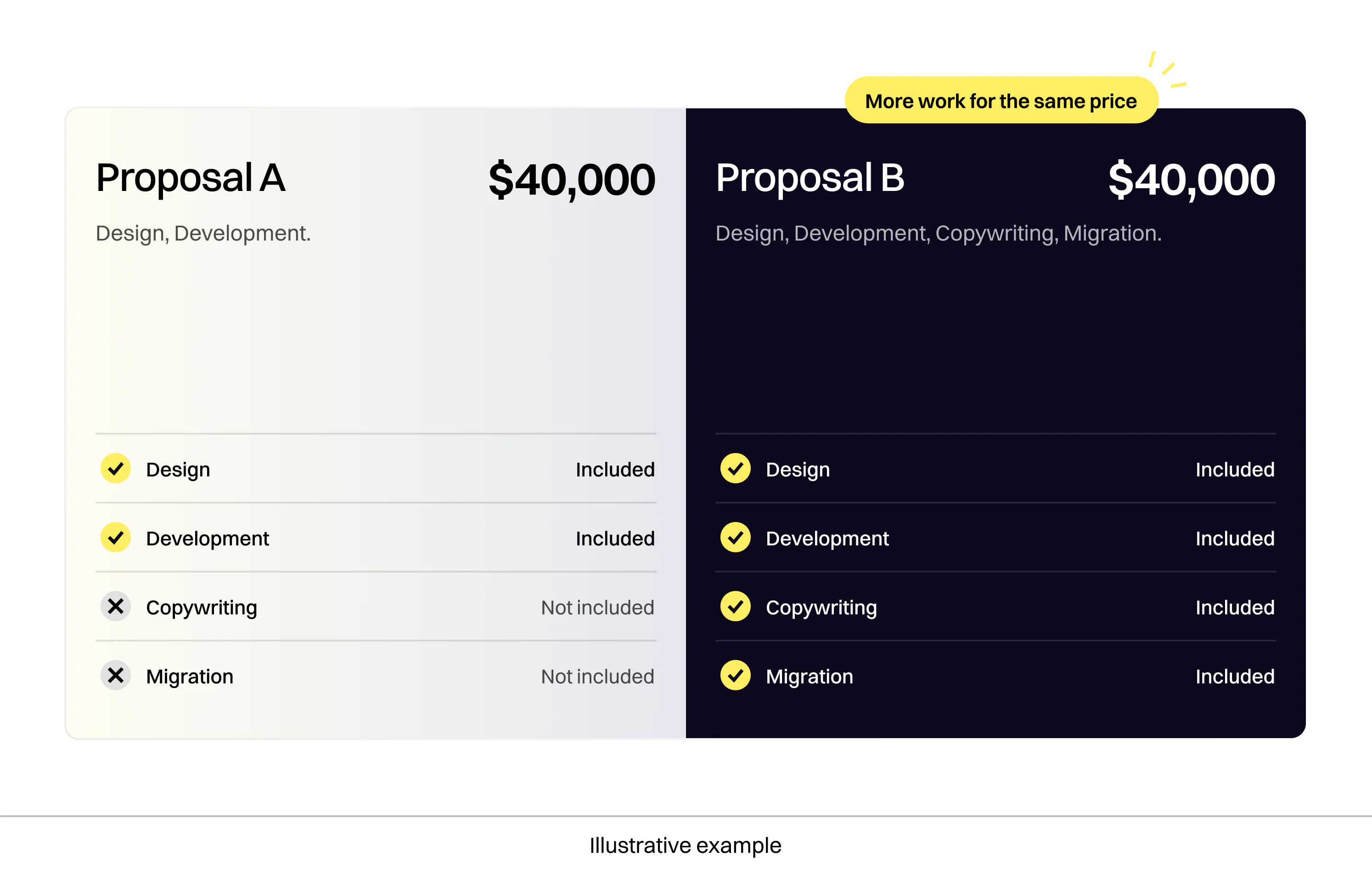
A $40,000 proposal can be more expensive than another $40,000 proposal in practice if it excludes copywriting, migration, SEO, integrations, or post-launch support that the second agency includes.
Look at how each team has divided the project.
A serious corporate website proposal should make it possible to understand what happens during discovery, what will be designed, what will be developed, who owns the content, which integrations are included, how migration will work, what will be tested, and what happens after launch.
Pay particular attention to assumptions and exclusions.
For example, “content provided by client” can represent a substantial amount of internal work. “CRM integration included” can mean anything from connecting a simple form to building more complex routing and data flows. “SEO included” may mean basic metadata or a full redesign migration plan.
If two agencies have interpreted the brief differently, the proposal stage is the right time to resolve that difference.
Should Every Agency Receive the Same Budget
If you are formally comparing agencies, usually yes. Give every shortlisted agency the same:
- business requirements;
- budget range;
- timeline;
- known constraints.
This makes it easier to compare how different teams would solve the same problem.
Without those shared inputs, one company may propose an ambitious custom build while another assumes the client wants the smallest possible project. Prices won’t tell you much if agencies price different scopes.
Proposals do not need to look identical. Their differences can show how each agency prioritizes the work within the same constraints.
When Should You Keep the Budget Flexible
A budget range should leave room for changes when key project details are still unknown.
What can change the estimate?
- An integration turns out to be more complex than expected.
- Preserving the current URL structure requires additional migration work.
- A content audit shows the company needs 40 new pages instead of ten.
If this happens, the agency should explain what changed and what the additional work will cost. That is different from a proposal gradually expanding without explanation.
Clear change control matters whether the engagement uses a fixed-price or time-and-materials model. VALMAX describes fixed-price engagements as suitable for projects with clear requirements, while time-and-materials work is intended for projects where needs may evolve.
The contract model should reflect how predictable the scope is.
How VALMAX Approaches Website Budget and Scope
VALMAX is a US-based web design agency working with B2B companies on strategy, branding, UX/UI design, website development, SEO, and post-launch support.
What the Process Includes
The corporate website process starts with discovery. The team interviews stakeholders to understand the business, product, and goals, then reviews existing materials and analytics and researches the market and competitors.
Those findings inform the site structure. From there, the project moves through:
- wireframes and design;
- development and QA;
- launch.
How VALMAX Estimates a Project
A detailed technical brief is not required to start a conversation. The team can gather requirements, research the niche, and recommend an appropriate structure.
The estimate depends on factors such as:
- page count and site structure;
- design requirements;
- advanced functionality.
VALMAX prepares the estimate after discussing the project requirements.
To get started, bring the business problem, goals, known constraints, and a budget range if one is available. The team can then define the proposed scope and explain what affects the estimate.
Website Design Brief Budget Checklist
| Question | Check |
| We have a realistic target range or have stated that the budget is not yet approved | ☐ |
| We have clarified whether the upper number is flexible or a hard ceiling | ☐ |
| The brief explains which agency services the budget should cover | ☐ |
| Content responsibility is clear | ☐ |
| Known integrations and technical dependencies are included | ☐ |
| Migration and existing SEO value have been considered | ☐ |
| Launch requirements are separated from optional features | ☐ |
| Post-launch support is either included or explicitly excluded | ☐ |
| Agencies are being asked to state assumptions and exclusions | ☐ |
| Shortlisted agencies receive the same core project information | ☐ |
| We will compare proposals by scope and approach rather than price alone | ☐ |
| If the budget is uncertain, we are asking for phased or scenario-based options | ☐ |
Key Takeaways
- Include a realistic budget range in most website design briefs. It helps agencies evaluate project fit and recommend an appropriate approach instead of guessing what the company can approve.
- A range is usually more useful than one unexplained number. State whether it is a target investment, provisional range, or hard ceiling.
- Budget and scope need to appear together. A $40,000 budget means very little unless the agency knows whether it should cover strategy, copy, design, development, integrations, migration, and support.
- Sharing a budget does not replace transparent estimation. A proposal should still explain deliverables, assumptions, exclusions, and optional work.
- If the budget is unknown, do not invent one. Give agencies enough information to estimate the project and ask for realistic scope options.
- When the desired scope exceeds the available investment, prioritize or phase it. Reducing the price without reducing the work is not a credible solution.
- Compare agency proposals by what they include. Similar totals can represent substantially different amounts of research, content, technical work, and post-launch support.
- Current market data confirms that web design pricing varies widely. Clutch’s 2026 data places web design projects broadly between $2,000 and $100,000, while VALMAX publishes separate higher planning ranges for custom B2B and enterprise corporate websites. The relevant figure for any one project depends on scope and complexity.
Frequently Asked Questions
Should you include your budget in a website design brief?
Should I tell a web design agency my maximum budget?
Is a website budget range better than an exact number?
Will a web design agency charge more if I share my budget?
What should a website design budget include?
What if I do not know my website budget?
Say so directly and provide a clear description of the goals, expected scope, functionality, content, integrations, and timing. Ask agencies to recommend a core scope and, where useful, a more complete option.
GET A TEAM THAT’S ALWAYS ON YOUR SIDE
Retainer Contract gives you reliable support whenever you need it
rate this article
5 / 5.0

based on 1 reviews