A corporate website design company plans, designs, and builds a company’s primary web presence. Strong agencies start with positioning research and buyer mapping before any wireframe is drawn. Budget $20,000–$100,000 depending on scope; timeline runs two to five months. The clearest signal of quality: case studies that explain what changed after launch, not just what the site looks like.
Why Corporate Website Design Requires a Different Approach
A corporate website solves a different problem than a campaign page, a startup landing page, or an e-commerce storefront.
A campaign page optimizes for one conversion. An e-commerce site helps visitors find and buy products. A corporate website has to work for several audiences at once: potential clients, investors, future hires, and partners, each arriving with different questions and different thresholds for credibility.
A manufacturing company may need to speak to procurement teams, distributors, and investors simultaneously. A cybersecurity firm has to establish trust with enterprise buyers while explaining technically dense services. A consulting company balances thought leadership, case studies, and lead generation on the same site.
That complexity is why corporate website development starts with strategy. Agencies that get this right spend time understanding how the company is positioned in the market, who the primary decision-makers are, and what information actually influences buying decisions. Without that foundation, even a visually impressive build can struggle to generate results.
This matters particularly for B2B organizations in the United States, where buying cycles are longer and involve multiple stakeholders. For companies operating in competitive markets across Chicago, Dallas, New York, Austin, or San Francisco, buyers compare several vendors, review case studies, and evaluate credibility before speaking with anyone. The website becomes part of the sales process, whether a company accounts for it or not.
What Corporate Web Design Services Include
A professional corporate website project typically starts with discovery: competitor analysis, audience research, and a review of existing site performance, all before any design decisions are made. This phase establishes what the site needs to accomplish and for whom.
From there, the work moves into information architecture: which pages are needed, how content is organized, and how different audiences navigate to what they are looking for. Strong architecture makes complex organizations legible without overwhelming visitors.
Visual design and development follow. Experienced teams build scalable systems covering typography, spacing, navigation patterns, and responsive behavior rather than designing pages in isolation. Development may involve WordPress, Webflow, custom CMS components, CRM integrations, multilingual functionality, or motion design, depending on requirements. The final stage covers QA, SEO implementation, redirect planning, and post-launch monitoring.
Project timeline by stage:
| Project Stage | Typical Duration |
| Discovery and Research | 1 to 3 weeks |
| UX and Architecture | 2 to 4 weeks |
| Design | 3 to 6 weeks |
| Development | 4 to 10 weeks |
| Launch and QA | 1 to 2 weeks |
How to Evaluate a Corporate Website Design Company
Start with case studies before anything else.
Good case studies explain the business challenge, the reasoning behind key decisions, and what changed after launch. A portfolio filled with homepage screenshots may show visual skill, but it reveals nothing about strategic thinking. Agencies worth hiring talk about post-launch outcomes: search performance, lead quality, sales cycle length, without being asked.
Ask how they handle discovery. Corporate website development projects involve more stakeholders than almost any other web project: marketing, leadership, legal, sales, and sometimes investors. Agencies without a structured approach to stakeholder alignment lose weeks to revision cycles.
Ask about content. Messaging often receives less attention than design, despite having a greater influence on conversions. Companies that delay content decisions until the final stages ship polished sites that still fail to communicate value clearly.
Technical capability matters for the long game. Enterprise buyers in the US increasingly expect fast, accessible, and multilingual-ready corporate websites. The underlying system should support new service areas, content programs, and market expansions without requiring a full rebuild two years later.
Agencies that ask uncomfortable questions early: what differentiates you, where sales conversations succeed or fail, what outcomes define project success, reveal more about their quality than any presentation.
Corporate Website Agency Comparison
| Factor | Boutique Agency | Mid-Size Agency | Enterprise Agency |
| Average project cost | $8,000 to $30,000 | $25,000 to $80,000 | $80,000 to $250,000+ |
| Timeline | 4 to 10 weeks | 8 to 20 weeks | 16 to 40 weeks |
| Strategy depth | Varies | Usually included | Always included |
| Custom CMS | Sometimes | Usually | Always |
| Motion and 3D | Rarely | Sometimes | Usually |
| Best fit | Small B2B, startups | Growth-stage, mid-market | Enterprise, global brands |
| Main risk | Capacity limits | Slower iteration | High overhead |
A 30-person B2B software company in Chicago has different requirements than a multinational manufacturer operating across North America. The goal is to find an agency whose experience aligns with the actual complexity of the project, not to assume that larger automatically means better.
How Much Does Corporate Website Development Cost?
Pricing varies significantly depending on scope, content requirements, and how much the agency handles versus the client.
$15,000 to $30,000 covers a smaller site of 10 to 15 pages with limited customization. Suitable for professional services firms or organizations with straightforward content structures.
$30,000 to $80,000 is where most B2B organizations in the US fall. At this level, projects typically include discovery workshops, UX planning, custom design, content support, SEO foundations, and a scalable CMS.
$100,000 and above apply to enterprise builds: multilingual content, advanced integrations, motion design, custom applications, and complex stakeholder management.
One thing consistently underbudgeted: copywriting. Messaging work adds cost depending on page count, and skipping it is one of the most common reasons a well-designed corporate website underperforms. Proposals that exclude strategy, content planning, and post-launch support may look cheaper upfront, but the gaps show up within six months.
Why Many Corporate Website Redesigns Fail
A redesign does not fix a positioning problem. If a company cannot clearly explain its value proposition, changing layouts and color palettes will not resolve the underlying issue. The website reflects the clarity of the business, or the absence of it.
Too many internal opinions without a single decision-maker produce sites that say nothing clearly. When every stakeholder has veto power and no one holds final authority, revision cycles expand, and the result is a homepage that tries to please everyone and convinces no one.
Content is almost always prepared too late. Organizations spend months on visual design while leaving copy decisions until the final weeks. Content determines whether a project launches on schedule and whether the launched site performs. Design cannot compensate for pages that fail to answer a buyer’s actual questions.
Redesigns that begin without defined success metrics have no way to measure whether the investment worked. Knowing the site needs to look better is not a business objective. Knowing it needs to increase qualified inbound leads from enterprise buyers in the US, reduce sales cycle length, or support a new market entry: those are goals an agency can actually build toward.
What Buyers Actually Look For Before Contacting a Company
Most corporate website traffic does not come from visitors ready to contact sales. By the time someone lands on a services page, they are comparing several providers, reviewing case studies, and trying to reduce risk before committing to a conversation.
B2B buyers across North American markets typically evaluate three things before reaching out. First, evidence that the company understands their industry. Second, proof that similar projects have been delivered successfully. Third, confidence that the company will be a reliable partner well after the engagement starts.
This is why case studies remain among the most visited sections on corporate websites. A good case study explains the business challenge, the approach taken, and the outcome. It helps a prospect understand whether the company has solved similar problems before and whether they can be trusted to solve theirs.
Buyers also pick up on signals companies often overlook: team expertise, industry-specific experience, awards, certifications, client testimonials, and the quality of written content. Individually, these elements seem minor. Together, they determine whether a visitor keeps reading or leaves.
What Successful Corporate Websites Have in Common
The corporate websites that perform well share a quality that has nothing to do with visual trends. They are built around a clear understanding of who the buyer is and what that buyer needs to believe before reaching out. Every structural and content decision follows from that.
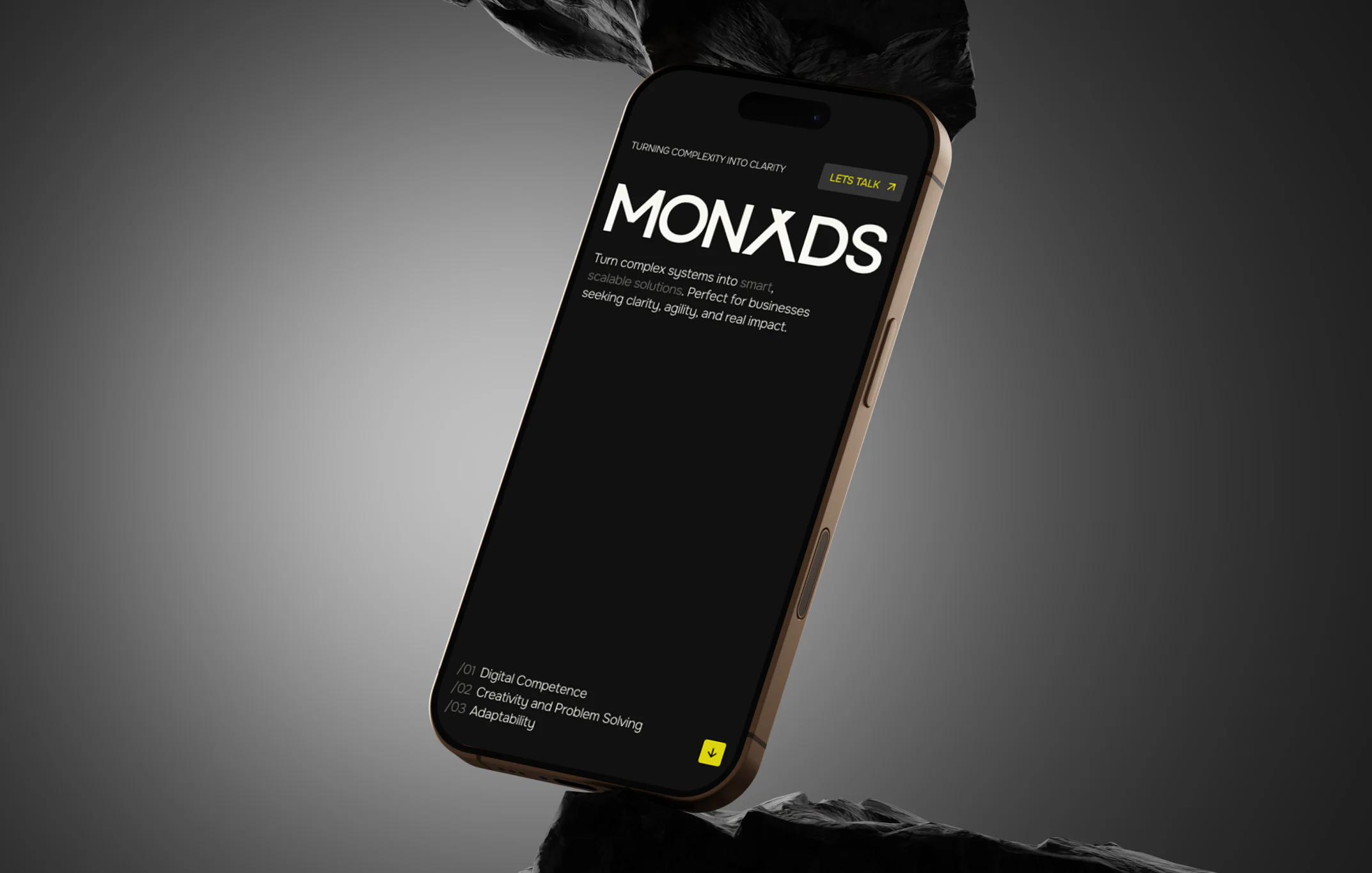
Monads, SAP Consulting, Switzerland
Monads is a Switzerland-based consulting and systems integration company specializing in SAP services, with consultants working as independent experts inside complex enterprise environments. The company had outgrown its website and hired VALMAX to rebuild its brand and site from the ground up.
Problem: Monads’ visual identity and content structure no longer matched the scale of its work. Action: VALMAX ran a three-month project covering brand identity, motion design, and web development. The team started with brand archetype mapping (Creator and Sage for expertise, Rebel for independence) and used those archetypes to guide every interface decision, including how sections unfold and how the contact flow behaves. Result: the redesign won an Awwwards Honorable Mention and a CSS Design Awards Site of the Day, and shipped on schedule. Managing Partner Fabian Diehl confirmed the on-time delivery.
Lineal, LegalTech, USA
Lineal helps legal teams and corporations manage large volumes of data for collection, analysis, and decision-making in complex cases. The company operates globally on a follow-the-sun model and offers seven proprietary tools built on the Relativity platform. Its old website was technically fragile, so Lineal hired VALMAX to rebuild it.
Problem: Lineal’s website required constant technical support and said nothing about the company’s real scale or product range. Action: what started as a redesign grew into a full rebuild once VALMAX mapped the full scope of Lineal’s services. VALMAX gave each of the seven Amplify applications its own page built around a specific use case, added a search-optimized resource center, and launched the site in eight languages, including Chinese, on a single design system built to hold up across dense legal terminology. Result: VP of Marketing Kate Schilling called the process flexible and responsive, and the site now holds up across dense legal content in any language.
Teknowledge, Technology, Europe
Teknowledge is a global technology company operating across multiple brands with more than 6,000 experts. The company needed one cohesive identity across all of them and brought in Valmax to build it from scratch.
Problem: Teknowledge’s enterprise-scale story was fragmented across multiple brands with no cohesive identity. Action: VALMAX built a ground-up redesign with bold visuals, 3D motion, and a site architecture designed to hold the full brand family together while staying navigable. Result: Teknowledge now has one navigable system that scales across brands without losing coherence.
All three projects started with a positioning question before any design decision was made.
Final Thoughts
A corporate website either supports or undermines your sales process every day it is live. The ones that hold up over time are built by agencies that understand buyer behavior, can manage stakeholder complexity, and measure success by business outcomes rather than visual awards alone.
For US-based B2B organizations evaluating corporate web design services, the difference between a $40,000 expense and a $40,000 investment is whether the agency treats the project as a design execution or a business problem.
Key Takeaways
- Corporate website development typically takes two to five months and costs $20,000 to $100,000 or more depending on scope
- Strategy and information architecture should come before visual design; agencies that skip this phase produce sites that look polished but underperform
- Case studies that explain post-launch outcomes are the most reliable way to evaluate a corporate website design company
- Messaging and copywriting are consistently underbudgeted, yet carry more influence on conversions than layout decisions
- Redesigns fail most often because of unclear positioning, too many stakeholders with no single decision-maker, or content prepared too late
- Enterprise buyers across the US evaluate credibility through case studies, team expertise, and content quality before reaching out
- A corporate website is an ongoing business asset; treating the launch as the finish line means falling behind within a year
FREQUENTLY ASKED QUESTIONS
What should I prepare before briefing an agency?
Five things: who your primary buyers are and what they need to believe before contacting you; your main competitors and how you differ; examples of sites you think work well and why; your current site’s biggest weaknesses; and a realistic budget range. The more specific the brief, the faster an agency can tell you what’s actually possible.
How do I know if I need a full redesign or a targeted refresh?
Rebuild if positioning has shifted, navigation is broken, or your CMS is so outdated the team avoids it. Refresh if the structure is sound but specific pages underperform or the visual design is dated. A direct answer should take an agency no more than 30 minutes of conversation.
How much of our team’s time will this actually take?
Plan for a point person who can turn around feedback within 48 hours during discovery and review cycles, plus two or three hours a week from marketing and leadership at key milestones. Projects slow down not from agency delays but from internal sign-off taking weeks instead of days.
Who owns the website and its files once the project ends?
For any agency worth hiring, you do source files, CMS access, and content included. Confirm this in the contract before work starts, along with what happens if you want to switch agencies or bring maintenance in-house later.
Is support included after launch, or is that a separate cost?
Most proposals cover a short warranty period (typically 30 to 90 days) for bug fixes, then move to a separate retainer or hourly arrangement for updates, new pages, and content changes. Ask what’s included in each phase before signing.
GET A TEAM THAT’S ALWAYS ON YOUR SIDE
Retainer Contract gives you reliable support whenever you need it
rate this article
1.3 / 5.0

based on 76 reviews