A B2B website should be structured around what buyers know when they arrive and how the company actually sells.
Use Products when customers already know the category, model, or specification they need. Use Services when the service itself is a familiar buying category. Lead with Solutions when prospects start with a problem or desired outcome. Use Industries when the offer, requirements, or proof change substantially between verticals. Use Who We Help or audience pages when different decision-makers genuinely need different information.
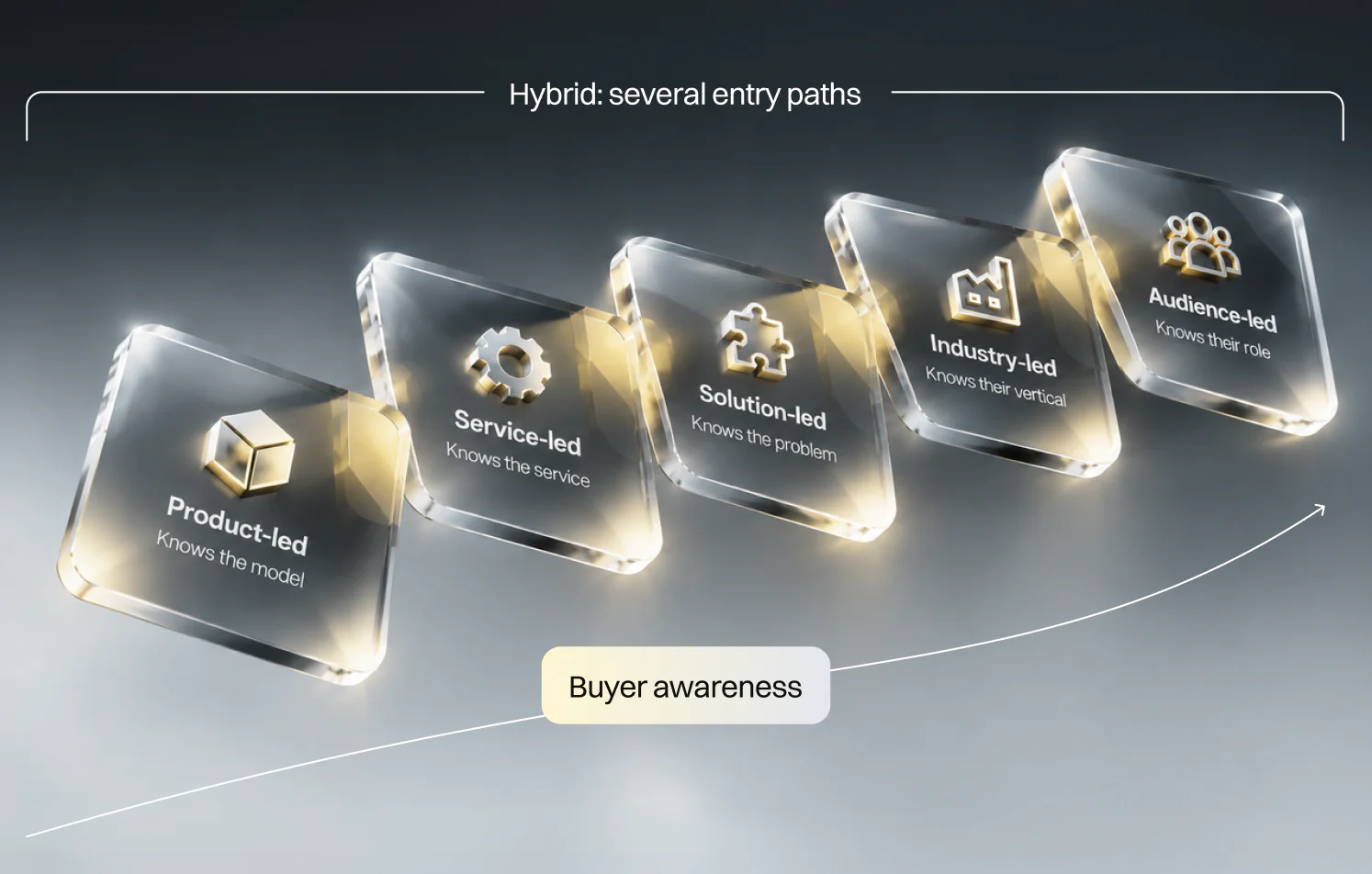
Complex B2B companies often need a hybrid structure. A website can lead with Solutions + Industries + Who We Help while keeping Products visible for technical and returning buyers.
The main question is simple: what does the buyer know before they arrive on the site?
Which Website Structure Is Best for a B2B Company?
There is no single best B2B website architecture.
A manufacturer selling standardized components may need a product-first catalog. A consulting firm may organize the site around recognizable services. A technology company may have several products, but customers actually buy a broader business outcome. Another company may serve healthcare, energy, and manufacturing with different requirements in each vertical.
The structure should reflect those differences.
This matters because B2B research increasingly happens before direct sales contact. Gartner reported in 2026 that 67% of surveyed B2B buyers preferred a sales-representative-free experience, while 45% had used AI during a recent purchase.
That means the website has to do more than display the company’s internal offer. It needs to help buyers recognize their situation, understand the available path, evaluate fit, and decide what to do next.
Product-Led vs Service-Led vs Solution-Led vs Industry-Led vs Audience-Led
In this article, product-led refers to website information architecture, not Product-Led Growth.
| Approach | Best for | Main advantage | Main risk |
| Product-led | Manufacturers, hardware, mature software categories | Direct product discovery | Site becomes a catalog without enough buyer context |
| Service-led | Consulting, agencies, engineering, professional services | Clear presentation of the offer | Internal service names may not match buyer intent |
| Solution-led | Complex B2B, enterprise technology, integrated offerings | Connects the offer to customer problems | Requires strong positioning and customer knowledge |
| Industry-led | Companies serving distinct verticals | Makes vertical relevance visible | Pages become repetitive if the offer barely changes |
| Audience-led | Multi-stakeholder buying processes | Gives each role a relevant path | Too many persona routes complicate navigation |
| Hybrid | Complex businesses with several products, markets, and buyer types | Supports multiple valid journeys | Requires disciplined information architecture |
The right model depends on how buyers describe their need, not on how the company organizes teams internally.
When Should a B2B Website Be Structured Around Products?
Product-first architecture works when buyers already understand the category and commonly arrive looking for a product family, model, part number, specification, or technical feature.
This is common in manufacturing, industrial equipment, components, hardware, electronics, and established software categories.
A typical path is:
Products → Product Category → Product Family → Product
The benefit is speed. A buyer who already knows what they need can reach specifications, documentation, variants, pricing information, or an RFQ without moving through several explanatory pages.
Google also recommends keeping important product pages reachable through a clear hierarchy of links from categories to subcategories and individual products. It uses page relationships and internal linking to understand site structure and relative page importance.
The weakness appears when customers understand the problem but not the product.
A buyer may know they need to reduce downtime, improve inspection accuracy, or automate reporting but have no idea which product family solves that problem. If the site forces them to understand the company’s taxonomy first, the navigation is asking too much too early.
In that case, Products should remain easy to access, but another entry path should lead the experience.
When Should a B2B Website Be Service-Led?
Service-led architecture works when customers already know the type of service they need.
For example:
Web Design → Web Development → Branding → UX/UI Design
or:
Engineering Consulting → Process Optimization → Compliance → Automation Consulting
These categories work because buyers recognize them before contacting the provider.
Service pages can also align well with strong commercial search intent. Someone searching for corporate website development already understands the category and wants to compare providers, scope, process, and proof.
The model becomes weaker when service names reflect internal capabilities rather than customer language.
A prospect may not know whether a problem requires “Digital Transformation,” “Operations Consulting,” or “Technology Enablement.” They know that five systems do not exchange data and reporting takes three days.
When customers describe the problem more easily than the service, solution-led navigation becomes more useful.
When Should a B2B Website Be Structured Around Solutions?
Solution-led architecture begins with a customer problem, use case, or desired outcome.
Instead of asking: Which product do you need?
the site helps answer: What are you trying to solve?
A technology company might use:
Reduce Operational Costs
Automate Quality Control
Improve Supply Chain Visibility
Modernize Legacy Systems
Each solution page can then connect the problem with the relevant products, services, proof, and next step.
This approach is particularly strong for complex B2B businesses because buyers often purchase an outcome that depends on several parts of the offer. A solution may include software, consulting, integration, support, and hardware even if those pieces are sold separately.
A strong solution page should explain the customer problem, why it matters, what approach is recommended, which parts of the company’s offer support that approach, and what evidence shows that the solution is credible.
Where solution-led structure fails
The main risk is vague positioning.
Labels such as Transform Your Business, Drive Innovation, or Unlock Growth are weak navigation choices because almost any company could use them.
Solution categories should come from real sales conversations, customer research, recurring objections, CRM data, or clear use cases.
If sales consistently hears the same problem in different words, that is often a stronger candidate for a solution page than an internally invented marketing phrase.
When Should You Use Industry-Led Architecture?
Industry pages are useful when the buyer context changes meaningfully between verticals.
A B2B company may serve:
Manufacturing
Healthcare
Energy
Financial Services
The underlying offer may stay similar, while the reasons to buy change.
Healthcare buyers may care about data privacy and regulatory requirements. Financial services companies may focus on auditability and security. Manufacturers may prioritize production uptime, integration with operational systems, and equipment constraints.
A useful industry page should therefore contain information that is genuinely specific to that market: relevant challenges, products or services, requirements, proof, use cases, and case studies.
If five industry pages contain the same copy with the industry name replaced, the structure adds little value.
Google’s current guidance for generative AI search specifically advises against creating large amounts of near-duplicate content simply to capture every possible query or fan-out variation. It recommends useful, original, non-commodity content instead.
Industry pages should exist because the buyer needs different information, not because another keyword exists.
When Should a Website Be Structured Around Audiences?
Audience-led architecture works when different roles in the buying process need substantially different information.
For example:
For Architects
For Engineers
For Contractors
For Facility Managers
The product may be the same, but the evaluation criteria differ.
An engineer may need specifications and compatibility. An executive may care about risk and business value. Procurement may need supplier information and purchasing requirements. Operations may focus on implementation and maintenance.
Audience pages are useful when the role changes:
- what the buyer needs to understand;
- which proof matters;
- which content should appear first;
- which next step is relevant.
They are less useful when every persona receives nearly the same page.
A complex B2B sale may involve six or seven stakeholders. That does not mean the website needs seven Who We Help pages.
Create audience pages only when the information journey truly changes.
Can Products, Solutions, Industries, and Audiences Be Used Together?
Yes. Complex B2B businesses often need a hybrid architecture.
A company may use:
Solutions for problem-aware prospects.
Industries for buyers looking for vertical expertise.
Who We Help for roles with distinct evaluation criteria.
Products for buyers who already know the category or model.
These sections answer different questions, so they can coexist without competing.
Example of a hybrid B2B architecture
An industrial technology company might organize its website around Solutions such as predictive maintenance, quality control, and production monitoring. Its Industries section could explain how these solutions apply to manufacturing, energy, and healthcare, with relevant requirements and case studies for each sector.
Who We Help could provide tailored information for engineering, operations, and procurement teams. Products would hold the technical catalog, including sensors, monitoring systems, and software, with specifications and documentation on individual product pages.
These sections would link to shared product pages and case studies. Insights, Company, and Contact would complete the navigation.
The goal is not to send every visitor through all four sections.
A technical buyer can go directly to Products. A prospect with an operational problem can start with Solutions. A healthcare company can enter through Industries. An executive can start with Who We Help and then move into relevant solutions and proof.
One or two routes should still be more prominent based on the company’s sales model.
How Should Products Work Inside a Solution-Led Website?
Moving Solutions ahead of Products does not make product pages less important. It gives them a clearer role.
A solution page can own this sequence:
Problem → Business Impact → Approach → Relevant Products or Services → Proof → Next Step
The product page can then focus on:
What the product does → Specifications → Features → Compatibility → Documentation → Inquiry
This matters in complex B2B because those are different buyer questions.
Someone researching a problem needs help understanding the right approach. Someone already evaluating a specific product needs technical depth.
The same product can support several solutions without duplicating the entire product page under each one.
For example, one industrial sensor may support predictive maintenance, automated inspection, and production monitoring. Each solution page can explain its use case and connect to one authoritative product page.
How Do You Choose the Right Structure?
Start with five questions.
| Question | If the answer is yes | Prioritize |
| Do buyers usually know the exact product or category? | They search by model, product type, or specification | Products |
| Do buyers already know the service they need? | The service is an established buying category | Services |
| Do buyers begin with a problem or outcome? | Several parts of the offer may solve it | Solutions |
| Does the offer change substantially by vertical? | Different industries need different proof or requirements | Industries |
| Do roles need materially different information? | The role changes how the offer is evaluated | Who We Help |
| Are several of these true? | Buyers have multiple valid starting points | Hybrid structure |
What does the buyer know when they arrive?
A buyer searching for a specific compressor model needs a very different route from a COO trying to reduce energy consumption.
The architecture should match that level of awareness.
What does the company actually sell?
The answer is not always the product listed on the invoice.
A company may invoice for hardware and software separately while the sales conversation is about reducing downtime. Another may sell consulting services but win projects because of expertise in a particular industry.
The website should reflect how customers understand the value.
Does the offer change by industry?
If terminology, use cases, regulations, implementation, or proof change substantially, industry paths make sense.
If everything stays the same, dedicated industry pages may add unnecessary complexity.
Do different roles evaluate the offer differently?
Multiple stakeholders alone are not enough. Audience architecture becomes useful when each role needs materially different evidence or content.
How do successful sales conversations begin?
This is one of the strongest signals.
If prospects usually start with “Which product do you offer for X?”, product-first architecture may already fit.
If the first question is usually “Here is the problem we have. How would you solve it?”, the website should probably give Solutions more prominence.
The best architecture usually mirrors the logic of the sales conversation that already works.
When Does B2B Website Structure Require an Agency?
A smaller company with a limited offer can often reorganize navigation internally.
Agency involvement becomes more valuable when the architecture affects positioning, multiple buyer journeys, content ownership, SEO, CMS relationships, and the broader redesign.
Typical signs include:
- Products no longer match how sales presents the offer.
- Several services work together as one customer solution.
- The company serves several industries with different requirements.
- Technical and executive buyers need different information.
- The site contains a large amount of overlapping or outdated content.
- Products, industries, case studies, and resources need to be connected in the CMS.
- Existing search visibility must be preserved while URLs and page relationships change.
- The redesign includes positioning, UX, content structure, design, and development.
At this stage, the main question is no longer what to call a menu item.
The difficult work is deciding which page owns each piece of information, which paths should be primary, how content should cross-link, and how the CMS should support those relationships after launch.
Those decisions should usually happen during discovery and information architecture before detailed UI design begins.
Why Website Structure Matters for SEO and AI Search
Website architecture affects which page answers which type of search.
| Search intent | Best destination |
| Specific product | Product page |
| Recognized service | Service page |
| Business problem | Solution page |
| Vertical-specific need | Industry page |
| Role-specific need | Audience page |
| Evaluation and proof | Case study |
| Research question | Insight or resource |
Google uses links between pages to discover content and understand relationships. Important pages should remain reachable through real navigation and contextual links rather than existing only inside internal search.
The same foundation applies to AI Overviews and AI Mode.
Google’s current guidance says that core SEO best practices remain relevant because its generative AI features are grounded in the Search index and ranking systems. It also confirms that Google uses query fan-out to retrieve related supporting information for broader queries.
That does not mean companies should create a separate page for every possible variation of a search.
Google explicitly says there is no special AI-specific writing format, no special schema required for generative AI search, and no need to rewrite content repeatedly for every long-tail variation.
A stronger approach is to give genuinely different questions their own authoritative pages:
- the product page owns product facts;
- the service page owns a defined capability;
- the solution page owns the customer problem and approach;
- the industry page owns vertical context;
- the audience page owns role-specific priorities;
- the case study owns evidence;
- the insight owns detailed research or explanation.
This gives buyers, Google, and AI retrieval systems clearer content relationships without producing duplicate pages.
Avoid Building Five Parallel Versions of the Same Website
Hybrid architecture should create different entry paths, not five copies of the same information.
A product page should remain the authoritative location for product specifications. A solution page can summarize which products are relevant without copying all technical details. An industry page can explain market-specific requirements and link to the relevant solution. An audience page can reorder information around a buyer role without repeating the full service description.
This reduces maintenance risk and makes internal linking more meaningful.
It also protects the site from a common content problem: several pages targeting nearly the same intent and competing to explain the same thing.
Clear page ownership is one of the most important decisions in a complex B2B redesign.
How VALMAX Approaches Complex B2B Website Architecture
VALMAX starts web design projects with discovery, interviews, business and competitor research, and wireframing before moving into the final visual design. Its current web design service reports more than 170 web designs delivered, while the wider agency portfolio lists more than 300 completed projects.
The important point is that the structure changes with the business model.
The AMD digital catalog project was product-first. VALMAX designed the experience around clear product categories, filtering, search, specifications, documentation, variations, and pricing because B2B distributors needed to locate and compare technical hardware quickly. The catalog was delivered in three months and included full data migration.
Wingmen required a different type of communication. The company is a consulting and engineering firm serving food-processing plants across 29 countries, with work spanning production, automation, energy efficiency, quality, and compliance. VALMAX’s redesign focused on making that complex service offer easier to understand rather than turning the website into a technical product catalog.
These two cases show why B2B information architecture should not begin with a preferred menu pattern.
The project should begin with positioning, buyer knowledge, the sales process, and the relationship between products, services, industries, and audiences. The sitemap, wireframes, CMS model, conversion paths, and UI can then follow that logic.
VALMAX’s corporate website development process also places discovery and wireframing before development, with integrations, SEO, performance, QA, and launch handled as later stages of the same system.
For the conversion side of this work, see VALMAX’s guide to B2B Website Design Best Practices for Lead Generation, which explains how information architecture connects with buyer education, proof, forms, and qualified inquiries.
Is Your B2B Website Structure Ready for a Redesign?
| Question | Check |
| We know what buyers usually know when they first arrive | ☐ |
| The navigation uses buyer language rather than internal terminology | ☐ |
| Product-aware visitors can reach Products directly | ☐ |
| Solution pages correspond to specific customer problems or outcomes | ☐ |
| Industry pages contain genuinely vertical-specific information | ☐ |
| Audience pages exist only where roles need different information | ☐ |
| Every major page type has a clear ownership role | ☐ |
| Products, solutions, industries, cases, and resources are cross-linked | ☐ |
| Important pages are reachable through crawlable links | ☐ |
| We are not creating several pages for essentially the same search intent | ☐ |
| The architecture reflects how successful sales conversations begin | ☐ |
| The CMS can support the relationships between page types | ☐ |
| The structure can accommodate new products, markets, and content later | ☐ |
If several of these answers are unclear, the project probably needs discovery and information architecture work before detailed design begins.
Key Takeaways
- There is no single best B2B website structure. Products, Services, Solutions, Industries, and Audiences solve different buyer-navigation problems.
- Product-first architecture works when buyers already know what they need. It gives direct access to models, specifications, documentation, and commercial actions.
- Solution-first architecture is stronger when buyers begin with a problem or desired outcome. Products can remain visible as a secondary or supporting route.
- Industry pages need real vertical differences. Different terminology, requirements, applications, proof, or implementation justify a dedicated page.
- Audience pages work when buyer roles genuinely change the information journey. Multiple stakeholders alone are not enough.
- Hybrid architecture is often the right answer for complex B2B companies. Solutions, Industries, Who We Help, and Products can coexist when each section has a distinct role.
- Complex information architecture should be resolved before UI design. Page ownership, internal linking, CMS relationships, conversion paths, and SEO implications affect the entire redesign.
- SEO and AI visibility rely on the same foundation. Google’s current guidance emphasizes useful, original content, clear technical structure, crawlable pages, and existing SEO fundamentals rather than separate “AI pages” or special GEO markup.
Frequently Asked Questions
How should you structure a B2B website?
Should a B2B website be organized by products or solutions?
What is a solution-led B2B website?
When should a B2B website use Who We Help pages?
Can a B2B website use Solutions, Industries, Audiences, and Products at the same time?
Do I need a web design agency to restructure a B2B website?
Smaller navigation changes can often be handled internally. An agency becomes more useful when restructuring affects positioning, several buyer journeys, content architecture, SEO migration, CMS relationships, conversion paths, or the broader redesign. In those projects, information architecture should usually be defined before detailed UI design and development begin.
GET A TEAM THAT’S ALWAYS ON YOUR SIDE
Retainer Contract gives you reliable support whenever you need it
rate this article
5 / 5.0

based on 1 reviews