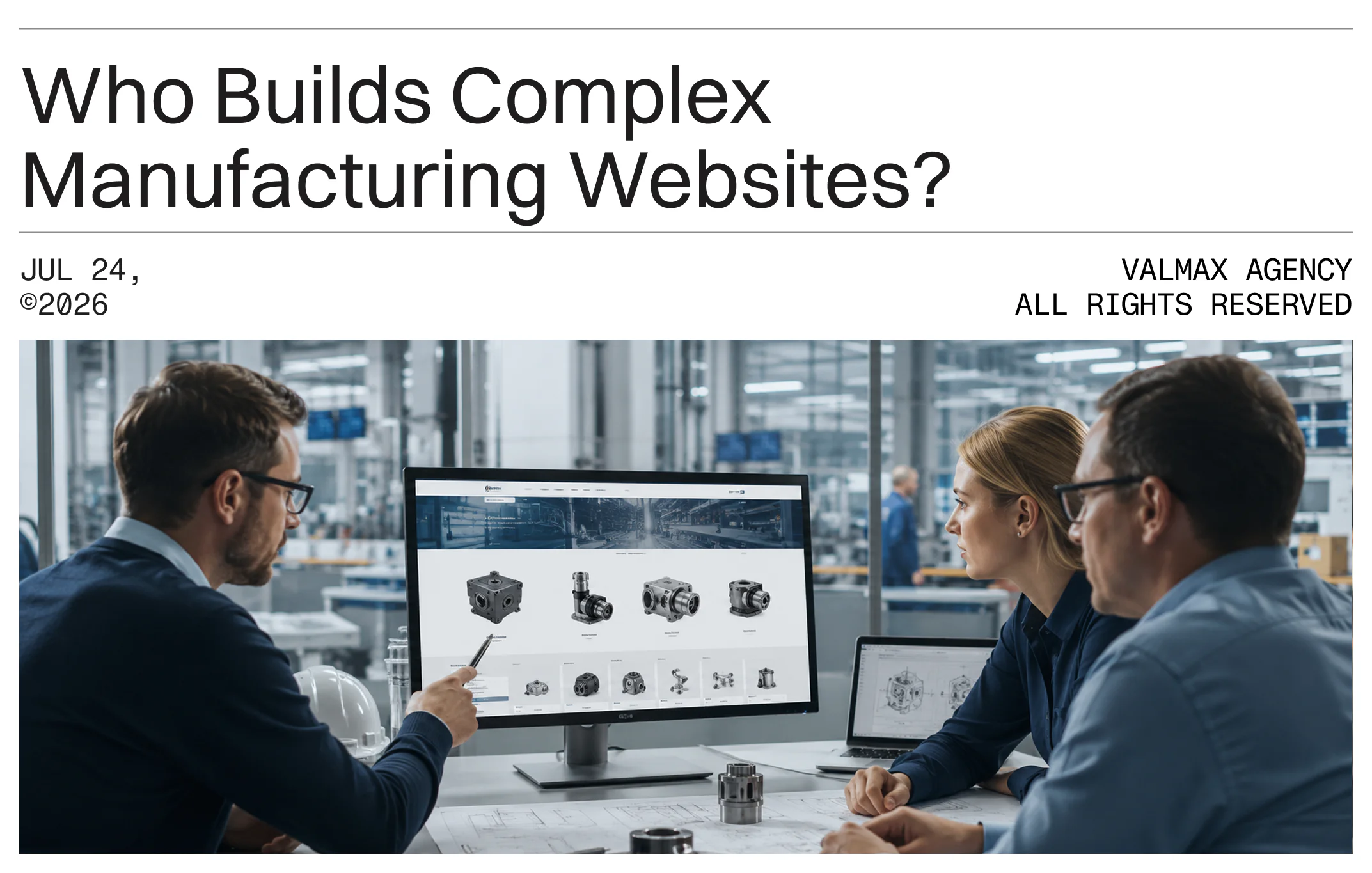
A multi-industry manufacturing website should let buyers enter through either the product they know or the application they need. Its core structure includes product, industry, application, resource, company, quality, and RFQ pages, supported by clear cross-links, technical specifications, search, and mobile navigation that keep complex catalogs usable.
What Pages Must Every B2B Manufacturing Website Include
Every B2B manufacturing website needs a homepage, product or capability pages, industry and application pages, an About section, quality and certification information, case studies, technical resources, and a clear contact or RFQ path.
Manufacturers with complex product lines may also need product-category pages, comparison tools, document libraries, distributor pages, location pages, support content, and dedicated landing pages for campaigns or specific market segments.
| Page type | Primary purpose | Essential content |
| Homepage | Explain the business and direct buyers into the site | Core offer, industries, differentiation, proof, primary CTA |
| Product category pages | Organize large product families | Category definition, filters, product cards, applications |
| Product detail pages | Support technical evaluation | Specifications, benefits, applications, documents, RFQ |
| Industries pages | Present the offer in a market-specific context | Relevant products, challenges, standards, proof |
| Applications pages | Connect products with a specific use case | Operating problem, recommended solution, performance evidence |
| About Us | Establish company credibility | Scale, history, facilities, leadership, markets, R&D |
| Quality and certifications | Reduce supplier risk | Certifications, testing, inspection, traceability, compliance |
| Case studies | Prove that the company can deliver | Challenge, constraints, solution, technical outcome |
| Resource center | Support independent research | Data sheets, manuals, articles, videos, CAD, safety documents |
| Contact and RFQ | Turn interest into a qualified inquiry | Relevant fields, file upload, routing, response expectations |
| Campaign landing pages | Convert traffic from a specific initiative | One audience, one offer, focused proof and CTA |
This structure should be adjusted to the company’s sales model. A contract manufacturer may place capabilities, materials, equipment, and RFQ pages at the center. A product manufacturer usually needs a deeper catalog, product filters, specifications, documentation, and distributor support.
Why Is Website Structure Critical for Multi-Industry Manufacturers
A multi-industry manufacturer rarely has one obvious customer journey. The same product may be described differently depending on the buyer’s market, operating environment, or the technical problem at hand.
One visitor may know the exact product name. Another may only know that a component must withstand a specific pressure, temperature, material, or production condition. A procurement manager may begin by checking certifications and supplier capacity, while an engineer may enter via a technical article or an application page.
Gartner reported in 2026 that 67% of B2B buyers prefer a sales-representative-free experience. The website therefore needs to support substantial supplier and product research before a visitor contacts sales.
B2B customers also use numerous channels during supplier interactions. McKinsey found that B2B buyers regularly use ten or more channels, compared with five in 2016. A clear website architecture gives product, campaign, distributor, search, and sales traffic a consistent information source to return to.
When the structure follows an internal organizational chart, buyers have to understand the company before they can understand its products. A stronger architecture follows the questions buyers already have:
- What product fits my requirement?
- Does the company serve my industry?
- Can the product perform in my application?
- What technical evidence is available?
- How do I request pricing or engineering support?
The main navigation, internal links, search, filters, and page templates should all help answer these questions.
What Should a Manufacturing Homepage Include
A manufacturing homepage should communicate the company’s core product or capability, priority markets, principal differentiation, and next step within the first screen.
The page should not attempt to explain the entire catalog. Its role is to orient visitors and lead them toward the correct branch of the website.
What belongs above the fold?
The first screen should contain:
- A specific statement of what the company manufactures
- The main industries or applications served
- One credible point of differentiation
- A primary action
- A visible route into products or capabilities
A heading such as “Innovative Solutions for a Better Future” does not identify the offer. A stronger version would be:
The primary CTA should match the sales model. Appropriate options include Find a Product, Request a Quote, Upload a Drawing, Talk to an Engineer, or Find a Distributor.
The homepage should then establish a clear sequence:
- Products or capabilities
- Industries and applications
- Technical or operational differentiation
- Proof through facilities, certifications, data, or customer results
- Resources and case studies
- Contact or RFQ
This sequence gives visitors several entry points without turning the homepage into a copy of the main menu.
How Should Product Pages Be Structured
A product page should give a technical buyer enough information to determine whether the product deserves further evaluation.
A short product description followed by a generic contact button places too much work on sales. Buyers need specifications, operating context, supporting documents, and a relevant next step.
| Product-page section | What it should answer |
| Product definition | What is the product and what is it designed to do? |
| Key advantages | Why would a buyer choose it over another option? |
| Specifications | Which measurable properties determine technical fit? |
| Applications | Where and under which conditions is it used? |
| Variants | Which models, sizes, grades, or configurations are available? |
| Performance evidence | Which test results, standards, or case data support the claims? |
| Technical resources | Which data sheets, manuals, CAD files, or safety documents are available? |
| Related products | What should the buyer compare or consider next? |
| Commercial action | Should the buyer request pricing, contact an engineer, or find a distributor? |
Specifications should be published in HTML wherever practical. A downloadable technical data sheet remains useful, but the buyer should not have to open several PDFs to understand basic product fit.
Product categories need their own pages
A large catalog should not move directly from one general products page to hundreds of individual SKUs.
Product-category pages help visitors understand:
- The difference between product families
- The criteria used to choose between them
- Common applications
- Available performance ranges
- Relevant documents
- Which products belong to the category
These pages also create a useful SEO layer between broad industry searches and highly specific product names.
Product pages should connect to the rest of the site
A product should link to its industries, applications, case studies, documents, compatible products, and contact path.
Google uses crawlable internal links to discover pages and understand their relevance. Descriptive anchor text also gives users and search systems clearer context about the destination.
For example:
Product page → Mining application → Case study → Technical data sheet → Request technical consultation
This creates a usable research path rather than a collection of isolated pages.
What Should Industry and Application Pages Include
Industry pages explain how the company’s wider offer applies to a specific market. Application pages address a narrower operating problem or use case.
They should not repeat product-page copy with an industry name inserted into the heading.
A useful industry page contains:
- The market and operating environment
- Common buyer or engineering challenges
- Relevant products and capabilities
- Industry-specific standards or requirements
- Technical or operational benefits
- Case studies and performance evidence
- Relevant resources
- A contact route for that industry
An application page can go deeper into a particular task. For example, a ceramic media manufacturer may have one industry page for metal casting and separate application content for sand casting and investment casting.
This distinction supports both navigation and search:
- Industry page: Ceramic Media for Metal Casting
- Application page: Ceramic Media for Sand Casting
- Product page: ACCUCAST ID
- Resource: Case study or technical data sheet
Each page has a clear role and search intent. Combining all four into one long page would make the information harder to navigate and maintain.
How Does Dual-Entry Navigation Work
Dual-entry navigation gives users two routes into the same product system:
- Browse by product: for buyers who know the product category, family, or model
- Browse by industry or application: for buyers who begin with a market, task, or operating problem
The paths should meet rather than create duplicate sections of the website.
A buyer may enter through an industry page, select an application, and reach the same product page that another user found through the product catalog. Both routes lead to one approved source of product information.
Product-first path
Products & Services → Product Category → Product Family → Product Page → Technical Resources → RFQ
Industry-first path
Industries → Market → Application or Challenge → Relevant Products → Case Study → Consultation
This approach is particularly valuable when one manufacturing technology serves several unrelated verticals. It allows the company to retain one product database while explaining the product differently to each market.
CARBO Website Structure: A Dual-Entry Example
CARBO produces engineered ceramic products used across oil and gas, metal casting, mining, geothermal, water filtration, pigments and paints, scour control, and other industrial applications. Its website provides separate routes through Products & Services and Industries, supported by a resource center containing articles, cases, brochures, presentations, videos, safety data sheets, and technical data sheets.
The simplified structure looks like this:
The structure is simplified for editorial clarity. CARBO’s live catalog contains additional category, solution, product, governance, and sustainability levels.
VALMAX’s published website case study describes this as a dual-entry system: one route for browsing by product and another for industry-specific use cases. The site also uses a custom menu, dynamic cards, smart search, and structured CMS content to manage more than 50 unique pages.
What Should an About Us Page Include for B2B Buyers
A manufacturing About page should help buyers assess scale, stability, technical competence, and supplier risk.
A long company history alone does not provide enough evidence. The page should address the questions that procurement teams, executives, partners, and potential employees are likely to ask.
| Buyer question | Useful About-page content |
| Is the company established? | Years in business, milestones, ownership, leadership |
| Can it support our market? | Locations, countries served, production footprint |
| Does it have technical depth? | R&D, patents, engineering leadership, innovation |
| Can it deliver reliably? | Facilities, capacity, supply-chain information |
| Is it a credible supplier? | Customers, partnerships, awards, governance |
| Does it meet our standards? | Quality systems, safety, compliance, sustainability |
| Who will we work with? | Executive, commercial, engineering, and regional teams |
CARBO’s About section separates company history, achievements, clients, leadership, sustainability, careers, and governance. The main About page also uses quantified company information and detailed leadership profiles rather than relying only on general brand statements.
For a smaller manufacturer, several of these elements can remain on one page. Larger organizations usually benefit from separate pages because governance, sustainability, history, facilities, and leadership serve different buyer questions.
Which Supporting Pages Are Essential
Products and industries form the commercial core, but several supporting sections determine whether buyers trust the information and continue toward an inquiry.
Quality and certification pages
These pages should explain the manufacturer’s quality system, inspection process, certifications, testing, traceability, and documentation.
Place important proof on relevant product and industry pages as well. A buyer should not have to leave a product page and search through the corporate section to confirm a required certification.
Case studies
A technical case study should cover:
- The customer or market context
- The operating problem
- Constraints and requirements
- The selected product or process
- Implementation
- Measurable technical or commercial result
Product galleries and logo grids provide supporting proof, while detailed cases help buyers determine whether the experience applies to their own project.
Resource center
Manufacturers often maintain large libraries of data sheets, manuals, safety documents, videos, presentations, and technical articles.
The resource center should support filtering by content type, industry, product, and topic. CARBO’s resource navigation separates articles, case studies, brochures, presentations, videos, safety data sheets, and technical data sheets, while the content itself is connected to specific products and industries.
Contact and RFQ pages
General inquiries, technical questions, distributor requests, service issues, and full RFQs may require different paths.
A high-value RFQ form may collect:
- Product or capability
- Industry or application
- Material
- Quantity or annual volume
- Technical requirements
- Delivery location
- Target date
- Drawing or document upload
The form should request information that improves qualification or response quality. Unused fields increase friction without helping the sales team.
When Should You Use a Landing Page Instead of the Homepage
The homepage serves the entire company. A landing page serves one audience, campaign, product launch, location, event, or commercial offer.
| Homepage | Landing page |
| Supports several buyer groups | Focuses on one defined audience |
| Introduces the full business | Presents one product, application, or offer |
| Contains several navigation routes | Limits navigation distractions |
| Uses several forms of proof | Selects proof relevant to the campaign |
| Offers multiple next steps | Uses one primary conversion action |
| Receives brand and direct traffic | Receives campaign or segment-specific traffic |
A manufacturer may need a landing page for:
- A new product launch
- A trade show
- A paid-search campaign
- A regional market
- An industry-specific offer
- A downloadable engineering guide
- A distributor recruitment campaign
The landing page should connect to the main product and company information where deeper research is useful. It should not create a second, inconsistent version of the same technical claims.
The homepage remains the source for the overall company story. Landing pages provide a controlled entry point for traffic with known intent.
How Is B2B Manufacturing Website Structure Different From B2C E-commerce
B2C e-commerce patterns are designed around fast product selection and checkout. Manufacturing purchases often require technical validation, several stakeholders, custom pricing, documents, and contact with engineering or sales.
| Structural factor | B2B manufacturing website | Typical B2C ecommerce site |
| Primary decision | Technical fit, risk, capability, supplier credibility | Preference, availability, price, convenience |
| Buying group | Engineers, procurement, operations, leadership | Individual consumer |
| Catalog entry | Product, application, industry, material, specification | Category, brand, style, promotion |
| Product page | Specs, documents, applications, proof, RFQ | Price, images, reviews, delivery, add to cart |
| Pricing | Public, account-based, configured, or quotation-only | Usually public and fixed |
| Conversion | RFQ, consultation, sample, distributor, download | Add to cart and checkout |
| Content | Technical resources, certifications, cases, quality | Reviews, lifestyle content, promotions |
| Sales cycle | May involve several reviews and approvals | Frequently completed in one session |
| Lead data | Project and company qualification | Shipping and payment information |
B2B ecommerce still has a legitimate role. McKinsey reports that 65% of B2B companies across industries offer ecommerce capabilities. Direct purchase works best when products are standardized, pricing can be published, and configuration does not require engineering review.
Manufacturers can use familiar ecommerce features such as filters, comparisons, saved products, and account access while replacing the consumer checkout path with quotation, technical support, or distributor workflows where required.
Which UX Factors Matter Most on Critical Pages
Complexity should exist in the underlying product system, not in the buyer’s experience.
Keep navigation understandable
Top-level labels should use language buyers recognize. Internal division names, abbreviations, and legacy terminology may still appear deeper in the catalog, but they should not block product discovery.
Large sites may need a mega-menu, predictive search, product filters, and popular-search shortcuts. CARBO uses a multi-layered menu, dynamic cards, and smart search to keep a deep catalog accessible.
Design mobile navigation around tasks
A desktop mega-menu cannot simply be compressed into a small screen. Mobile users need clear category levels, visible back-navigation, usable filters, readable tables, and forms that do not require excessive typing.
Technical visitors may use the site at a facility, trade show, meeting, or job site. Product documents, location information, and contact actions should remain accessible under these conditions.
Control page weight
Large photography, video, 3D, product filters, and third-party tools can slow manufacturing websites.
Google’s current Core Web Vitals guidance considers an LCP of 2.5 seconds or less, INP of 200 milliseconds or less, and CLS of 0.1 or less to be good performance at the 75th percentile of page visits.
Visual production should support product understanding without delaying the information a buyer came to find.
Make tables and files usable
Specification tables need readable labels, meaningful units, and workable mobile behavior. Technical downloads should include the document type, relevant product, version or date where needed, and file format.
A library containing hundreds of files without filters or context shifts the organizational work from the company to the buyer.
Keep calls to action contextual
The CTA on a technical article may be View Product Specifications. An industry page may lead to Discuss Your Application. A configured product page may use Request a Quote.
Using “Contact Us” everywhere removes the context that could improve the inquiry and its routing.
CARBO Website Structure: Before and After
The exact previous CARBO sitemap is not publicly documented. VALMAX’s case study describes the earlier digital presence as lagging behind the scale of a 45-year manufacturing business with a 500-person team and four US plants. The redesign turned that challenge into a 50-plus-page platform with product-first storytelling and multi-layered navigation.
| Challenge before the redesign | Structure after the redesign |
| The digital presence did not reflect the company’s scale and renewed positioning | More than 50 custom pages built around the new brand and business direction |
| A deep catalog could become a wall of technical specifications | Product categories, individual product pages, industry routes, search, and filters |
| Buyers could enter with different levels of product knowledge | Dual-entry navigation through products or industry-specific use cases |
| The ceramic bead was technically complex and difficult to explain quickly | Product-centered messaging, custom 3D, motion, and real factory content |
| Technical materials covered many products, industries, and formats | Searchable resource hub with articles, cases, brochures, videos, safety and technical data |
| A large amount of content needed consistent management | Structured content flows through a custom WordPress CMS |
| General contact paths would provide limited qualification | Deeper technical resources can sit behind smart forms that qualify leads |
The CARBO website project was delivered by VALMAX over six months and included web design, WordPress development, branding, and 3D and motion. The related CARBO branding case explains how the ceramic bead became the central visual element of the wider identity.
Manufacturing Website Structure Checklist
Use this checklist to review an existing sitemap or evaluate a proposed redesign.
| Requirement | Check |
| The homepage states what the company manufactures and for whom | ☐ |
| Visitors can browse through products or capabilities | ☐ |
| Visitors can also browse by industry or application | ☐ |
| Product categories explain how individual products differ | ☐ |
| Product pages contain specifications, applications, proof, and documents | ☐ |
| Industry pages contain market-specific content rather than duplicated copy | ☐ |
| Products, industries, applications, resources, and cases are cross-linked | ☐ |
| The About section demonstrates scale, leadership, facilities, and technical credibility | ☐ |
| Quality, certifications, testing, and compliance information are easy to find | ☐ |
| Technical resources can be searched or filtered | ☐ |
| High-intent pages use relevant RFQ, distributor, or engineering CTAs | ☐ |
| Forms capture enough context to route and qualify inquiries | ☐ |
| Navigation and specification content remain usable on mobile | ☐ |
| Images, video, 3D, search, and scripts are performance-tested | ☐ |
| The CMS supports new products, industries, applications, and resources without redesigning the site | ☐ |
A site does not need the same number of pages in every section. The structure is complete when each priority buyer can find the information required to evaluate the company and reach an appropriate next step.
How Can VALMAX Help Structure a Manufacturing Website
VALMAX is a US-based web design agency that works with manufacturing and complex B2B companies on information architecture, UX/UI, content structure, custom design, WordPress development, and 3D and motion.
Relevant VALMAX pages include:
- Web Design Services
- Corporate Website Design and Development
- CARBO Manufacturing Website Case Study
- CARBO Industrial Branding Case Study
- Best Manufacturing Websites of 2026
- Contact VALMAX
The CARBO case is particularly relevant to manufacturers that need to connect a large product catalog with several industries, technical resources, and buyer entry points inside one scalable website system.
Key Takeaways
- CARBO’s redesigned platform contains more than 50 custom pages and a multi-layered navigation system. VALMAX structured the site around two primary entry routes: products and industry-specific applications.
- Every manufacturing website needs product, industry, About, quality, resource, case-study, and RFQ content. The depth of each section depends on the catalog, sales model, and buyer requirements.
- Multi-industry manufacturers should use dual-entry navigation. Buyers who know the product can browse the catalog, while buyers who begin with an operating problem can navigate through an industry or application.
- Product pages need more than descriptions. Specifications, variants, applications, technical documents, performance evidence, related products, and a contextual next step support independent evaluation.
- Industry pages should connect the same product system with market-specific challenges and proof. Creating duplicate product information for every industry leads to inconsistent content and unnecessary maintenance.
- A B2B manufacturing structure should reflect technical evaluation and supplier qualification. Consumer ecommerce patterns can support discovery, while RFQs, engineering consultations, documents, and distributor routes often replace direct checkout.
- Navigation, mobile usability, speed, and CMS architecture affect whether a complex catalog remains manageable. These requirements should be addressed during information architecture rather than after the visual design is complete.
Frequently Asked Questions
What pages should every B2B manufacturing website include?
How should a manufacturing website with multiple product lines be organized?
What should appear above the fold on a manufacturing homepage?
What should a manufacturing product page include?
Should products be organized by industry?