A manufacturing website is the primary tool a B2B buyer uses to evaluate whether a company can handle their project before a single conversation happens. The best manufacturing websites of 2026 are built around product clarity, technical credibility, and a content structure that serves both engineers and procurement leads at the same time.
Most industrial companies lose qualified prospects because their websites are organized around internal departments rather than how buyers actually think. A strong manufacturing website makes it immediately obvious what the company makes, who it serves, and why its process is worth trusting.
The standard has risen sharply. Buyers now expect the same quality of presentation from an industrial supplier that they would from an enterprise software company. Sites that were acceptable in 2021 are losing business today.
What Makes a Manufacturing Website Strong in 2026
The strongest manufacturing websites share a structural logic that is easy to miss when you are looking at individual design choices. Before the visual decisions matter, the underlying architecture has to be right. That means every page has a clear job: to answer a specific question a buyer might have at a specific stage of evaluation. Websites that fail usually fail because they were designed to look good rather than to communicate a structured argument for why this manufacturer is the right choice.
Clear product and capability pages are the foundation. An engineer evaluating a supplier needs to know material specs, tolerances, process capabilities, and lead times before they pick up the phone. If that information is buried in a brochure PDF or locked behind a contact form, the site has failed its core job. The best industrial websites surface this information in a scannable, structured format that works for someone who knows exactly what they need and for someone who is still figuring out whether the company fits their application.
Fast comprehension of what the company does matters more than most manufacturing companies realize. Procurement teams and engineers evaluate multiple suppliers simultaneously. A website that requires three clicks to understand the core product offering is a website that gets compared unfavorably to a competitor who explained it in the hero section. The homepage should answer the question, “What do you make and who do you make it for?” within the first two seconds of loading.
Technical credibility goes beyond listing certifications on an About page. ISO, AS9100, IATF 16949, and other industry-specific credentials should appear near the relevant product or capability pages, not isolated in a footer badge. Case studies with measurable outcomes, client logos from recognized brands, and process documentation all contribute to the kind of trust that shortens sales cycles. A buyer who can independently verify that the company has done this kind of work before is more likely to reach out without needing multiple calls to build confidence.
Industry-specific use case pages are becoming standard among the best industrial sites. Rather than listing capabilities generically, strong websites build dedicated sections for specific applications, materials, or end markets. This signals to the buyer that the company understands their context and has relevant experience. It also helps the website rank for more specific search queries, which tend to have higher conversion intent.
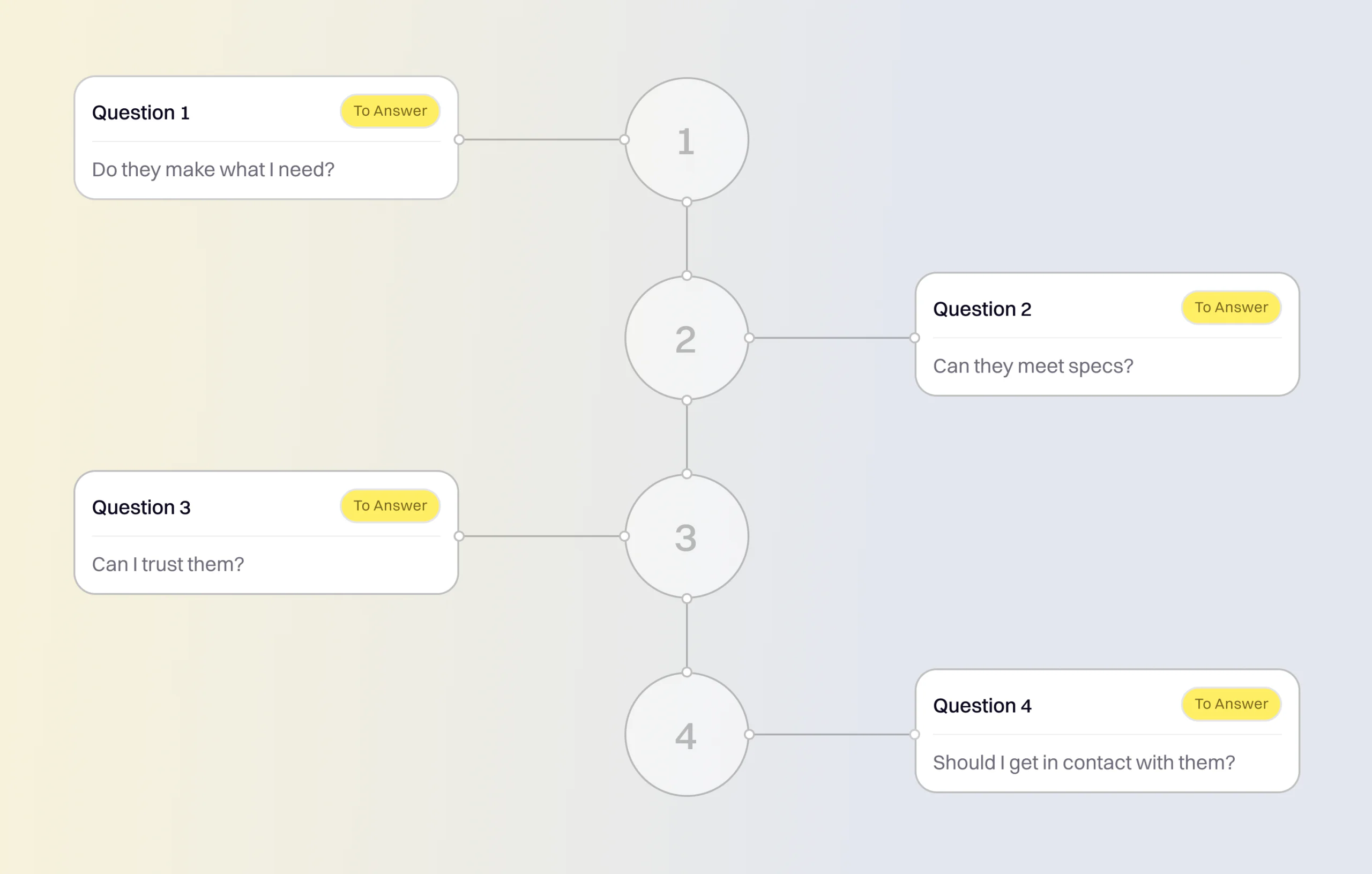
Navigation designed for multiple buyer types is a structural challenge most manufacturing websites get wrong. An engineer looking for material datasheets and a VP of Procurement looking for capacity, certifications, and references need different paths. The best sites create clear entry points for each without making the navigation feel cluttered. Mega-menus are common in enterprise manufacturing, but the design of those menus needs to be driven by buyer logic, not internal product hierarchy.
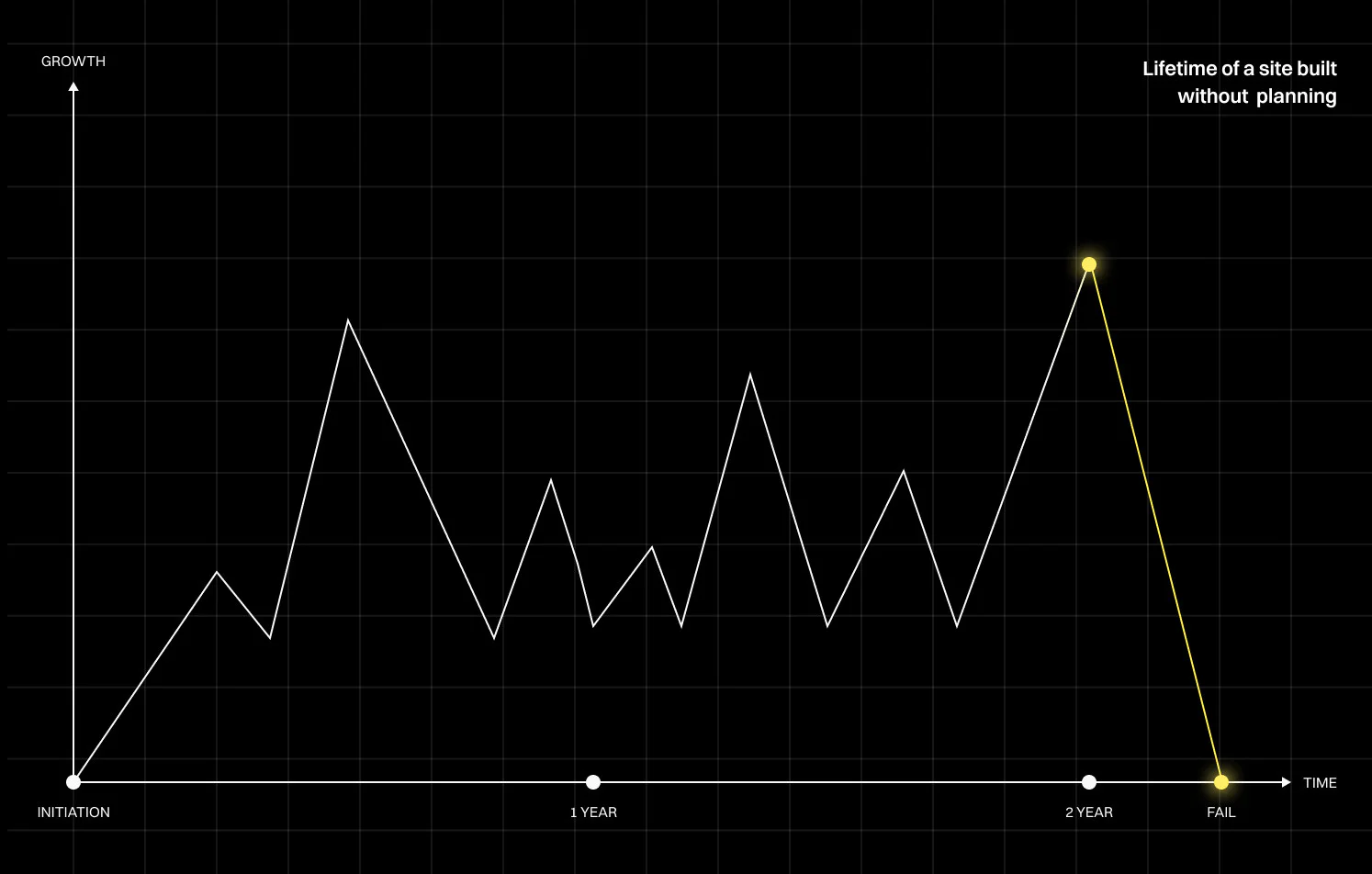
Scalable CMS architecture matters from day one. Manufacturing companies that launch a website without planning for product catalog updates, new case study additions, and application page expansions often find themselves with a site that is impossible to maintain 18 months after launch. A well-built WordPress or Webflow site with a structured content system allows the marketing team to update and expand the site without developer involvement for every change.
Strong visuals do not mean decorative visuals. The best manufacturing website designs use photography, 3D renders, and motion to communicate capability, not just brand. A 3D exploded view of a precision component tells an engineer more in three seconds than three paragraphs of description. A time-lapse of a production line communicates scale and process in a way that words cannot. Every visual should earn its place by making something clearer or more credible, not by filling space.
Performance and mobile quality cannot be treated as secondary. A significant portion of B2B manufacturing website traffic comes from mobile devices, especially from engineers who are on the floor, at trade shows, or traveling. A site that loads slowly or breaks on a phone sends a signal about operational standards that no branding work can undo.
Sales enablement through the website means treating it as a tool that the sales team can rely on. This includes downloadable spec sheets, RFQ forms that are actually easy to complete, clear contact paths that reach the right person, and enough information that a prospect can arrive at a first call already educated. Companies that invest in this infrastructure close deals faster because the website does the early qualification work.
Best Manufacturing Websites of 2026
1. CARBO
Website: carbo.tech
Industry: Manufacturing (Advanced Ceramic Proppant Technologies)
Location: Houston, Texas, USA
Services: Branding, Web Design, WordPress Development, 3D/Motion Design
Scope: 50+ pages, 6-month project
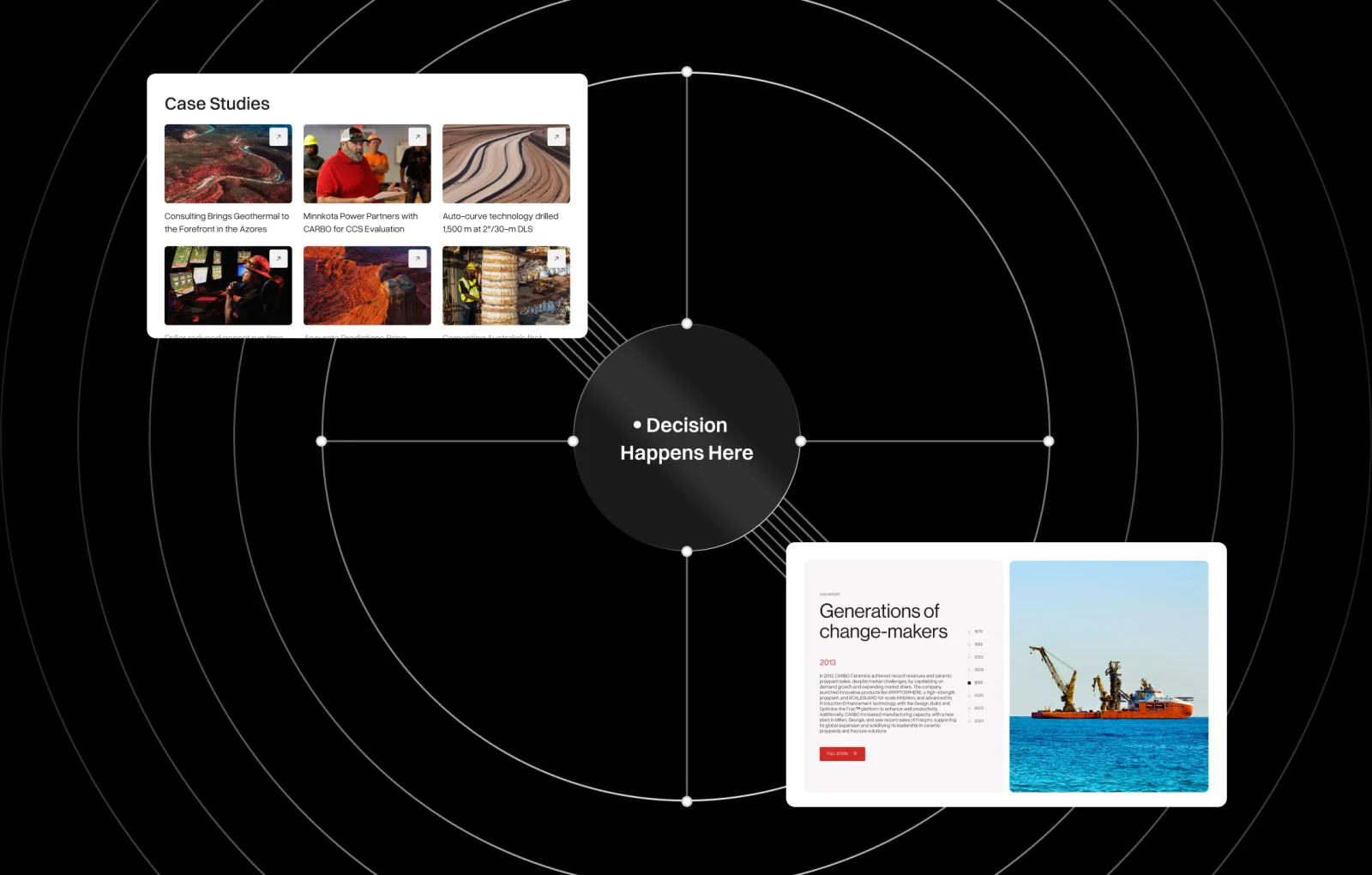
CARBO manufactures advanced ceramic proppant technologies used in demanding extraction environments. At VALMAX, the challenge was clear: explain a complex industrial product to a technical B2B audience without losing clarity or visual impact. The result is one of the strongest manufacturing website examples currently live in the US.
We built the experience around product storytelling. From the first screen, the site explains what CARBO makes and why it performs differently. The structure follows a logical path: what it is, how it works, where it’s used, and the proof behind it. This allows both technical and non-technical visitors to quickly understand the product and its value.
To solve a key communication gap, we introduced custom 3D and motion. Ceramic proppant works at a microscopic level in high-pressure conditions, which can’t be captured with standard visuals. The 3D makes performance visible, helping buyers evaluate the product without digging through technical documentation.
The site runs on WordPress with a scalable CMS, allowing CARBO’s team to expand content over time. With 50+ pages, the information architecture reflects how B2B buyers actually research: by application, product line, and technical specs. We handled branding, UX, design, and development as one system over six months, which shows in the final consistency.
This website was designed and developed by VALMAX — an industry-leading manufacturing web design agency.
The key takeaway is simple: complex products require clearer websites, not more complicated ones. This project shows what manufacturing website design can achieve when structure, UX, and branding are aligned from the start.

2. BOXO
Website: boxo.com.ua
Industry: Modular Construction, Container Buildings
Location: Ukraine
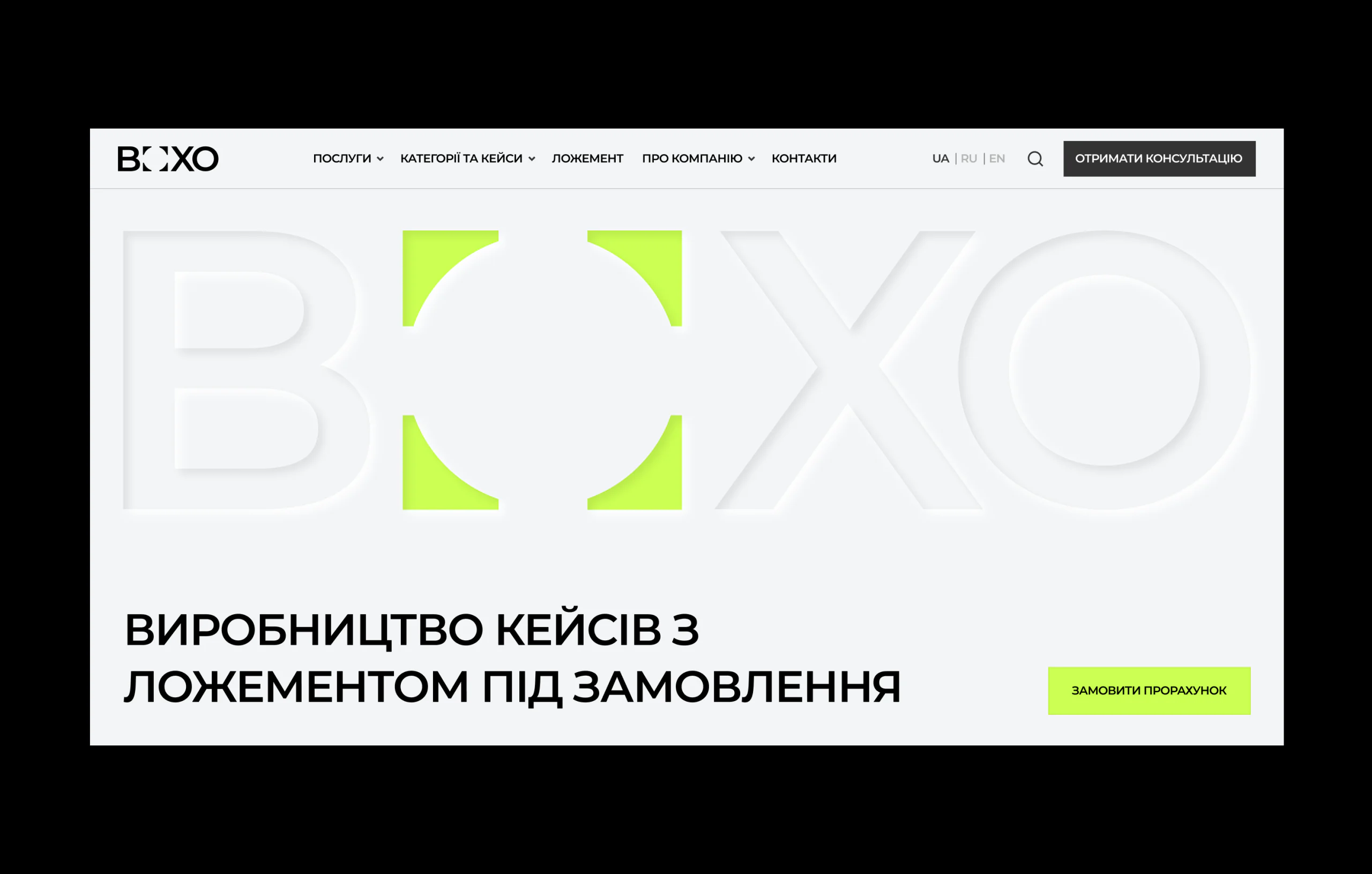
BOXO designs and manufactures modular buildings for residential, commercial, and industrial use. The website keeps the focus on completed projects, helping visitors quickly understand how modular construction can be applied across different scenarios, from offices and retail spaces to residential units.
The navigation is straightforward and built around practical use cases rather than technical terminology. This makes it easier for potential customers to explore solutions, compare project types, and move toward an inquiry without unnecessary friction. For companies operating in construction and manufacturing, that level of clarity is often more valuable than an extensive feature list.
Visually, the site relies on large project imagery and clean layouts that allow the work to speak for itself. Real examples create credibility and demonstrate the flexibility of modular construction more effectively than promotional claims. BOXO is a strong example of how a construction company can present complex, customizable solutions in a way that feels accessible, organized, and easy to navigate.
3. Novanta Photonics
Website: novantaphotonics.com
Industry: Advanced Photonics, Laser Processing, Precision Manufacturing
Location: Bedford, MA, USA
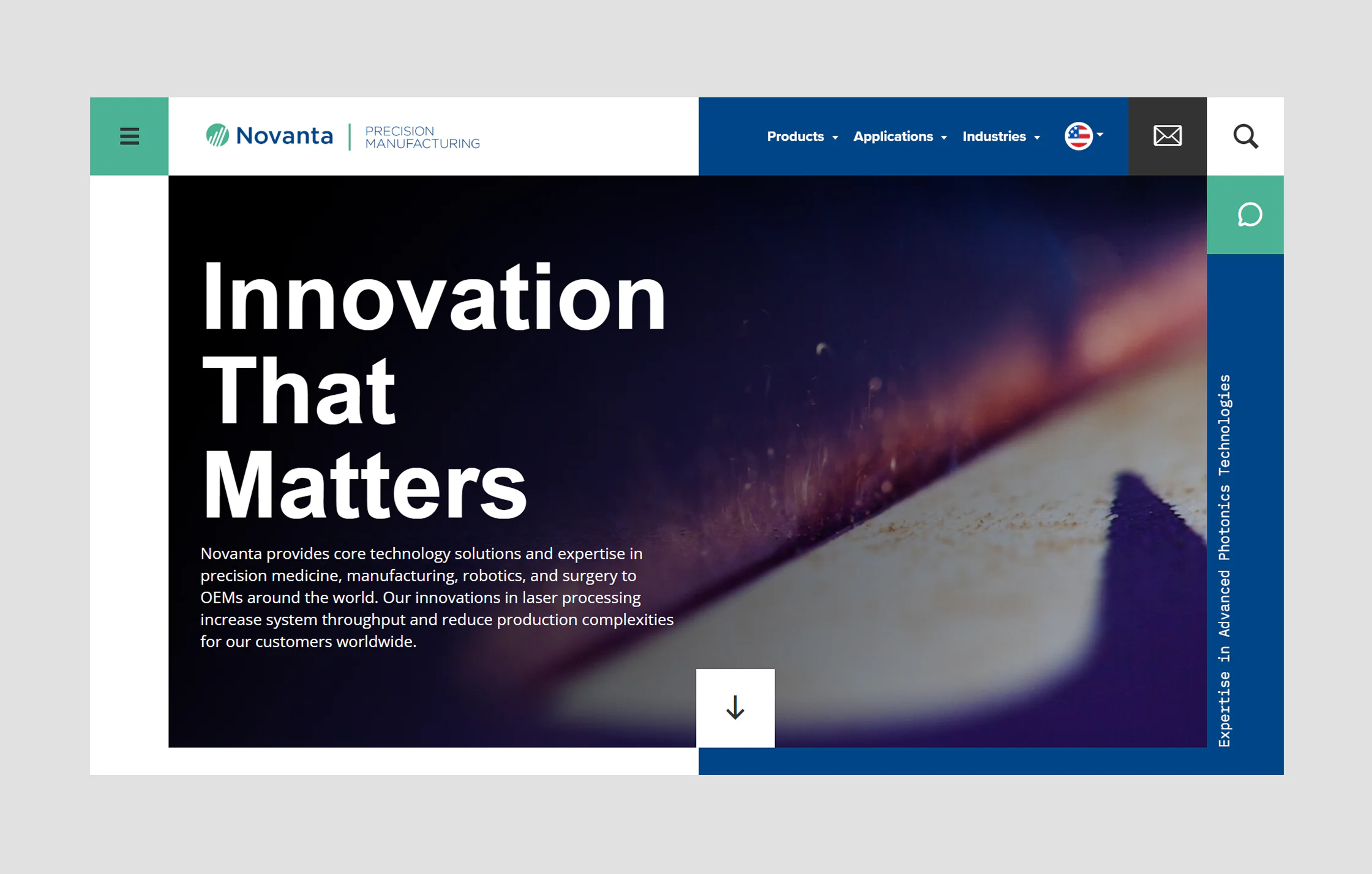
Novanta Photonics serves OEMs in medical and advanced industrial markets by supplying laser sources, beam delivery systems, and scanning components engineered for precision-critical applications. The website reflects the exact position Novanta occupies in its supply chain: a deeply technical component manufacturer whose buyers arrive with specific application requirements and need to verify that the products can meet those requirements before requesting a quote or sample.
The site’s navigation is organized by application, by technology, and by market, which maps directly to how photonics engineers actually search for components. Rather than presenting a flat product catalog, Novanta structures the website so that a buyer working on a medical laser system and one working on a battery electrode coating machine can both find their path quickly. The application note library and technical resource section signal to experienced engineers that this is a company capable of the engineer-to-engineer collaboration required by high-precision OEM relationships.
Where Novanta stands out from a web design perspective is the clarity of its technical credibility signals. ISO certifications, application testing capabilities, and proof-of-concept service offerings are positioned prominently near the relevant product pages rather than buried in a corporate section. This is exactly the right approach for industrial websites serving a technically sophisticated audience: validation needs to appear where the evaluation is happening, not at the end of the “About” section. Novanta is also a strong example of how multi-brand architecture can be managed without confusing visitors, using clearly differentiated sub-brand pages for Synrad, Cambridge Technology, Laser Quantum, and ARGES.
4. Onshore Technologies
Website: onshoretechnologies.com
Industry: Contract Manufacturing, Interconnect & Electromechanical Assemblies
Location: USA
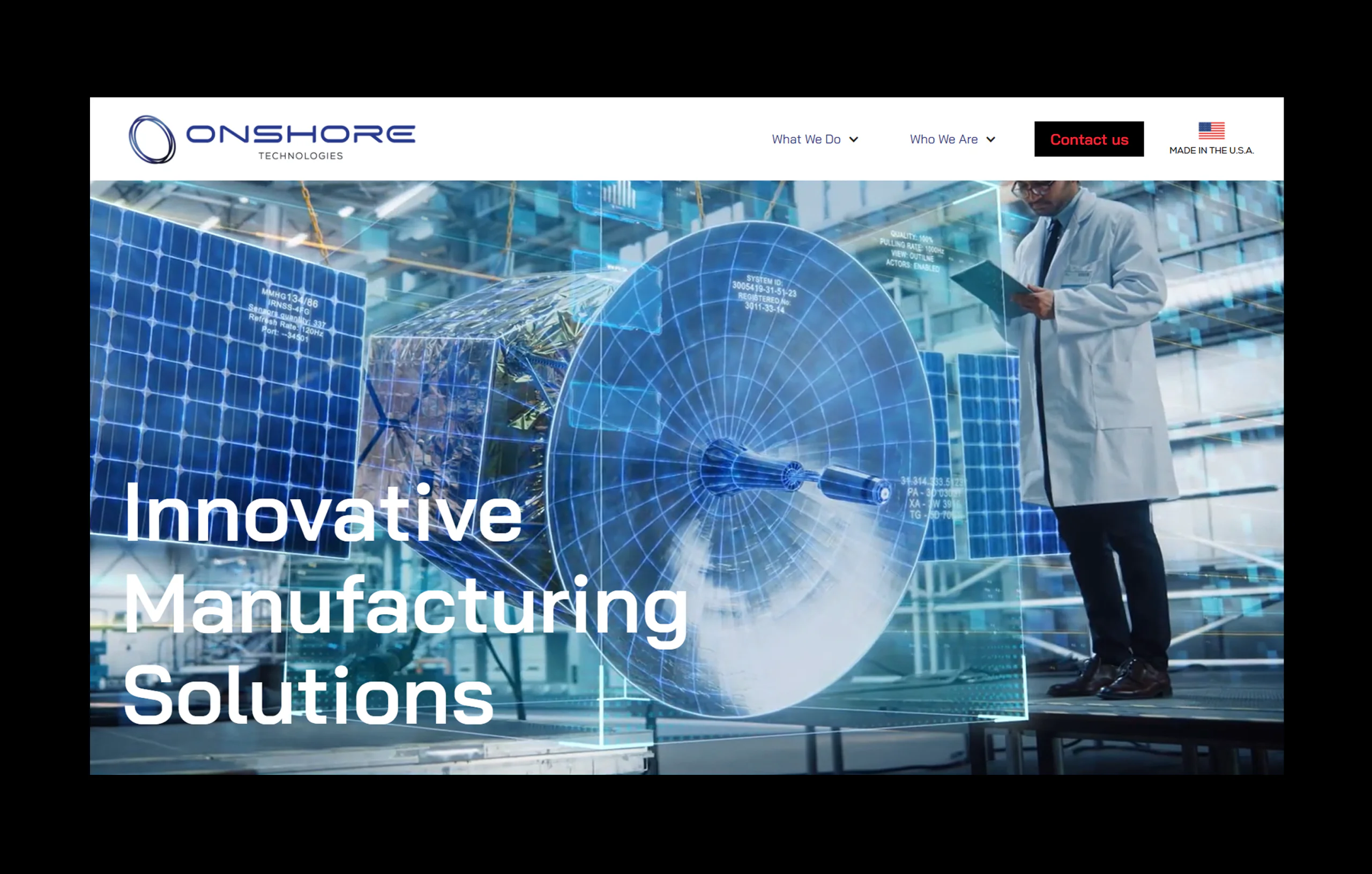
Onshore Technologies has been operating as a contract manufacturer since 1992, building interconnect and electromechanical assemblies across aerospace, medical, and defense applications. Its website reflects a company that has learned what its buyers need to see before they shortlist a contract manufacturer: quality certifications front and center, team depth and experience visible and specific, and a clear statement of what kind of manufacturing challenges the company is built to solve.
The homepage makes the company’s value proposition concrete quickly by combining years of experience, the certification standard (ISO 13485 and AS9100D), and the range of services from concept to production volume without burying the reader in generic language. Leadership bios are detailed in a way that is unusual for companies of this size and that works well because contract manufacturing relationships depend heavily on trust in the specific people running the operation. Giving buyers visible access to who they would be working with reduces the uncertainty that delays procurement decisions.
The product and capability architecture follows a logical from-concept-to-production-volume flow that mirrors the way buyers actually engage with contract manufacturers across a project lifecycle. This is smart information architecture: it meets the buyer where they are in their own process rather than forcing them into a product taxonomy that makes sense internally but confuses externally. For manufacturing companies that offer services across the project lifecycle, Onshore’s structure is worth studying.
5. Terminal Industries
Website: terminal-industries.com
Industry: Industrial Technology / AI Logistics Platform for Manufacturing
Location: Austin, Texas, USA
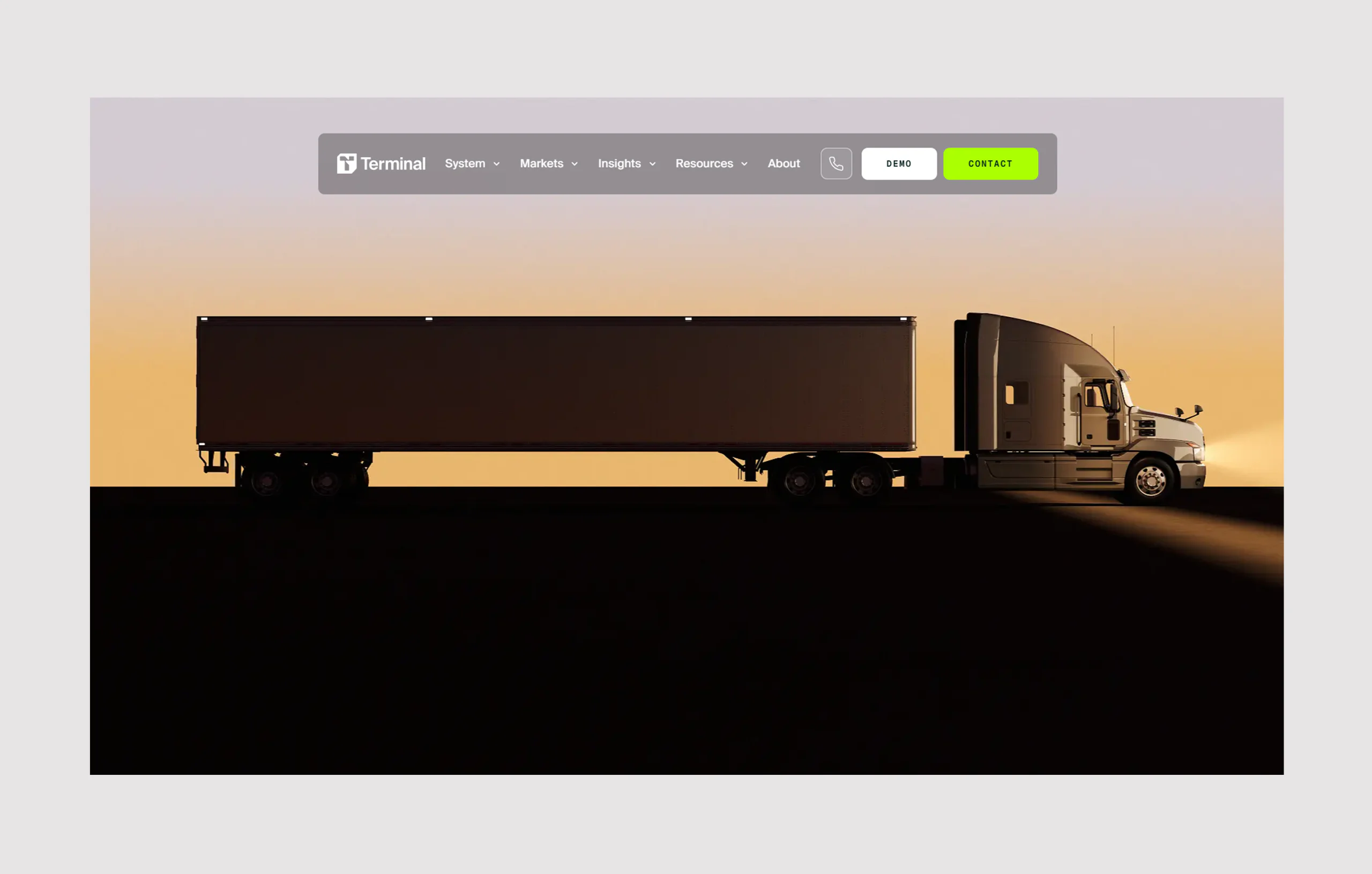
Terminal Industries builds an AI-native Yard Operating System for manufacturing facilities, distribution centers, and logistics operators. The company was recognized in the 2025 Gartner Market Guide for Yard Management and represents one of the more forward-looking examples of how industrial technology companies can use motion, scroll-triggered interaction, and narrative structure to explain a platform that would otherwise be difficult to visualize. Terminal’s product is invisible infrastructure. The website makes it visible and tangible.
The storytelling approach uses a problem-first structure that is well suited to selling operational technology to manufacturing companies. Before presenting the platform, the website frames the yard congestion problem in terms of its real cost: line shutdowns, missed delivery windows, and invisible inventory losses. By the time the product appears, the buyer already understands why it matters. This is the right sequence for any manufacturing website selling a product that buyers might not know they need yet. The design follows the argument rather than the feature list, which is a more persuasive structure for complex B2B solutions.
From a design execution standpoint, Terminal uses animation and scrollytelling in a way that serves communication rather than replacing it. The motion reveals how the platform works in real yard environments, which is more effective than a feature table. Manufacturing website designers can take from Terminal’s example the principle that motion should explain, not just decorate, and that even in industrial contexts, a well-paced narrative can outperform a static capabilities page.
6. Boeshield T-9
Website: boeshield.com
Industry: Industrial Corrosion Protection & Lubrication (Boeing-Licensed Technology)
Location: Holland, Michigan, USA
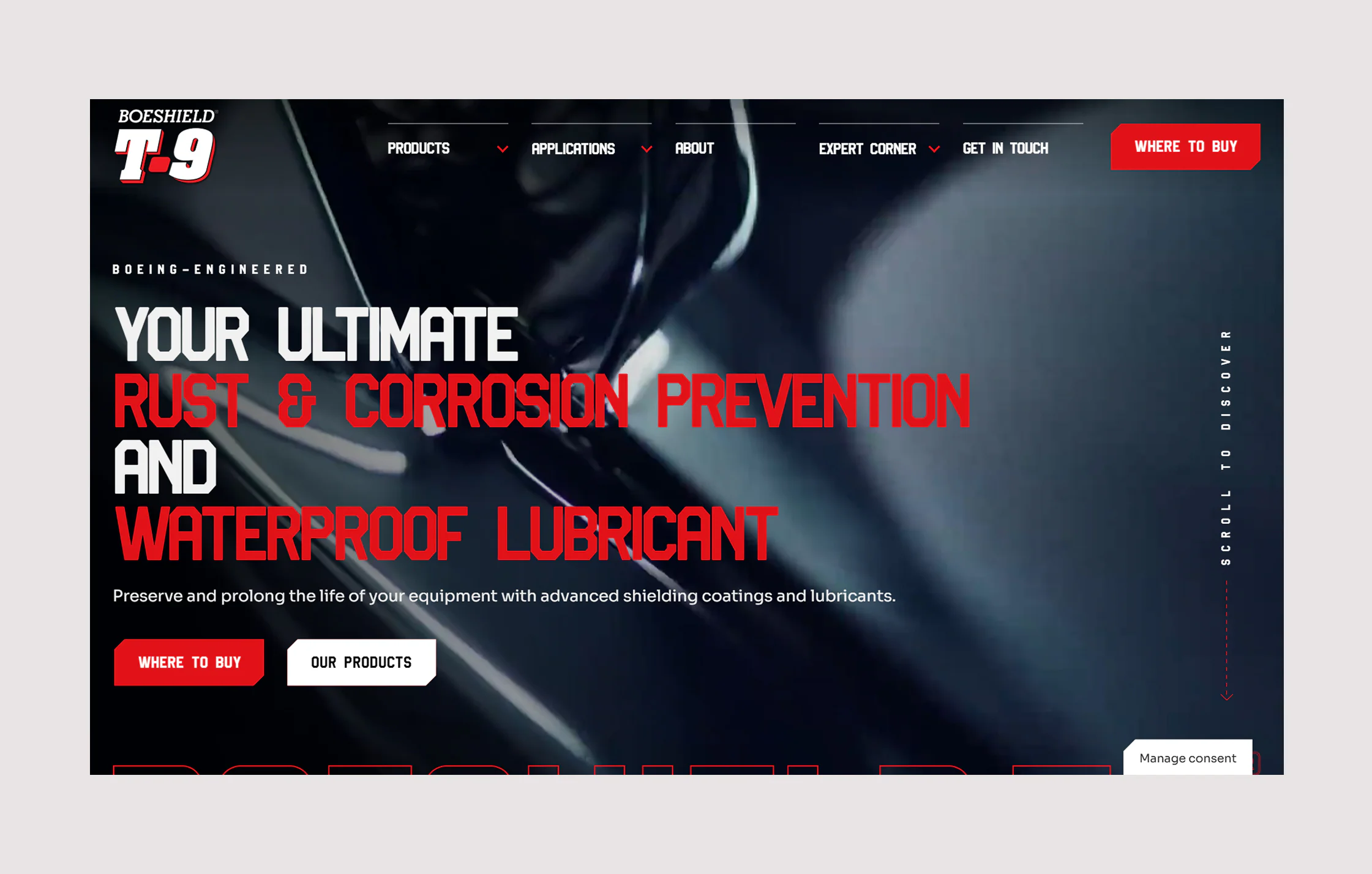
Boeshield T-9 is a corrosion protectant and lubricant developed and licensed by Boeing, distributed by PMS Products Inc. since 1982. The product’s origin story is the strongest credibility signal in the entire category: if it was engineered to protect aircraft components, it is qualified to protect anything. The website leads with this story, which is the correct decision. Industrial buyers evaluate protective products based on provenance and track record, and a Boeing-originated formulation is provenance that no competitor can replicate.
The site handles multi-audience navigation well for a product that serves industrial, marine, cycling, automotive, and consumer hardware markets. Rather than forcing all visitors into a single product page, Boeshield organizes entry points by use context, so a marine operator and a shop tool maintenance manager can both find the specific application information they need without working through irrelevant content. The market-specific landing pages also support SEO for highly specific search queries, which is where product websites generate their most qualified organic traffic.
What Boeshield demonstrates for manufacturing companies is the value of knowing and leading with your strongest differentiator. The Boeing licensing story is not buried in an about page; it anchors the brand at every entry point. If your manufacturing company has a comparable differentiator, whether a patented process, a military specification clearance, or a Fortune 100 client relationship, the website should lead with it visibly, not list it as a bullet point five scrolls into the page.
7. Jagenberg Group
Website: jagenberg.com
Industry: Industrial Machinery & Plants, Automation, Digital Solutions
Location: Krefeld, Germany
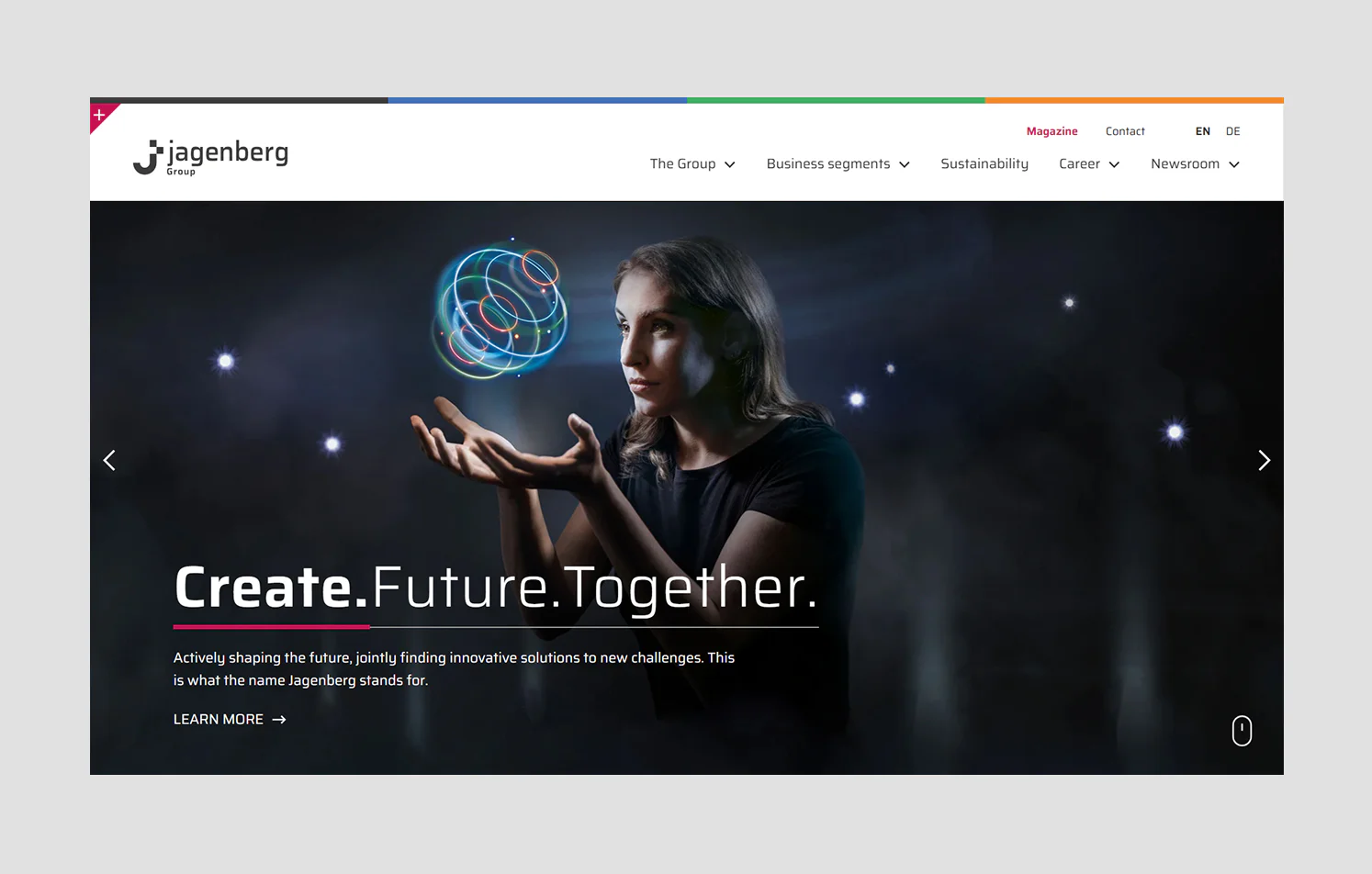
Jagenberg Group is a 140-year-old industrial manufacturer and machine builder, operating across machinery, automation, and connected digital systems for companies that process web-shaped materials. Its group website carries the weight of that history while presenting a current, organized structure that reflects the complexity of operating 19 subsidiaries across Europe, Asia, and the USA. For a company this large and this technically layered, the challenge of website design is always clarity: how do you communicate the full range of capability without overwhelming a buyer who comes in with one specific application in mind?
Jagenberg solves this by organizing the site around the three business pillars, Machinery and Plants, Automation and Drives, and Digital, and then building navigation depth beneath each. The structure works because each pillar corresponds to a real decision-making lane a buyer might arrive through. An engineer looking for electrode coating systems ends up in a completely different section from one evaluating IIoT connectivity platforms, but both experiences feel logical. The site does not try to funnel everyone to the same page. That is a mature UX decision that reflects a genuine understanding of how industrial buyers research suppliers.
The visual approach across the Jagenberg group properties is consistent and serious without being cold. Industrial photography of production environments grounds the brand in a real manufacturing context. The “Together” digital magazine is a genuinely smart content play for a group this size because it gives buyers a reason to return and signals that the company has genuine intellectual substance beyond product listings. Manufacturing companies with strong engineering cultures can look at Jagenberg as a model for how to communicate group-level capability while still leaving room for subsidiary-level specificity.
Manufacturing Website Comparison: Key Design and Trust Signals
The table below summarizes the seven examples covered in this article across industry niche, design approach, key trust signal, and CMS platform.
| Company | Country | Industry Niche | Design Approach | Key Trust Signal | CMS |
| CARBO | USA (TX) | Advanced Ceramics | 3D + Motion storytelling | Technical product clarity | WordPress |
| Jagenberg Group | Germany | Industrial Machinery | Pillar-based navigation | 140-year heritage | Enterprise CMS |
| Novanta Photonics | USA (MA) | Laser / Photonics | Application-first nav | Multi-brand architecture | WordPress |
| Onshore Technologies | USA | Contract Manufacturing | Lifecycle flow structure | ISO 13485, AS9100D | WordPress |
| Terminal Industries | USA (TX) | Industrial Technology / AI Logistics | Scrollytelling, motion | Gartner Market Guide 2025 | Storyblok |
| Boeshield T-9 | USA (MI) | Corrosion Protection | Market-specific landing pages | Boeing-licensed tech | WordPress |
| Hajster | Ukraine | Heat Pumps / Renewables | Premium consumer-style | Premium visual system | — |
Common Patterns Across the Best Manufacturing Websites
Looking across these seven examples, several structural and design decisions appear repeatedly in the highest-performing sites. These are not coincidental. They reflect how B2B buyers actually evaluate manufacturers, and they represent the decisions that separate websites that generate leads from websites that exist as digital brochures.
Product structure is always application-first or problem-first, never internal-org-first. The best manufacturing websites organize information around what the buyer is trying to accomplish, not around how the company’s departments are divided. This is the most common structural failure in industrial web design, and fixing it alone typically improves the time-on-site and conversion metrics measurably.
Homepage clarity is non-negotiable. Every site in this list communicates the core product and audience within the first viewport. This requires restraint. Most manufacturing companies want to feature everything on the homepage. The discipline of choosing one clear, specific message and building the rest of the page around it is what makes these homepages work.
Technical proof appears near the point of evaluation, not at the end of the page or in a separate corporate section. Certifications, process documentation, and case studies are placed within the product and capability pages because that is where the buyer’s confidence decision is actually being made.
Industry and application pages create specificity that generic capability pages cannot. A buyer searching for a precision machining supplier for aerospace applications will respond more strongly to a page titled “Aerospace Precision Machining” than to a general capabilities page that lists aerospace as one of twelve industries. Specificity signals experience and reduces the risk perception that B2B buyers carry into supplier evaluation.
Visual systems are consistent and purposeful across the best industrial websites. The photography, illustration style, and motion decisions feel like they were made by the same team using the same design logic. Inconsistency in visuals signals inconsistency in operations, which is a credibility problem for manufacturing companies where consistency is literally the product.
Motion and 3D elements serve explanation, not aesthetics. The sites that use them best, including CARBO and Terminal Industries, use them to make invisible or complex processes visible. Sites that use motion purely for visual interest tend to have higher bounce rates because the motion delays information access rather than accelerating comprehension.
Branding consistency between the website, product materials, and trade show presence matters more in manufacturing than in most other sectors because manufacturing companies often first meet buyers in person. When the website and the booth look like they came from the same company, it reinforces professionalism. When they do not, it raises questions.
Scalable content systems allow the website to grow with the business without becoming a maintenance burden. The manufacturing companies that maintain the strongest websites over time build them on CMS platforms that allow non-technical team members to add product pages, case studies, and application content without developer support for every update.
How to Choose a Web Design Agency for a Manufacturing Website
Most manufacturing companies make the mistake of choosing a web design agency the way they would choose a graphic design studio: based on portfolio aesthetics. The better evaluation criteria for B2B manufacturing website design are structural and process-oriented, because the hardest part of building a manufacturing website is not the visual design. It is the information architecture, the content strategy, and the technical development that together determine whether the site actually performs.
The most important filter is genuine B2B experience. An agency that has built consumer e-commerce sites and SaaS marketing pages has different instincts than one that has built industrial websites for companies selling to procurement teams and engineering managers. Ask to see case studies specifically from manufacturing, industrial, or technical B2B companies, and evaluate them for the quality of content structure, not just visual execution.
Complex case studies in the portfolio tell you more than the homepage design. Look for evidence that the agency understood a technically complex product well enough to explain it clearly. If the case study pages are vague about what the company actually made or did, that is a signal that the agency approached the project as an aesthetic exercise rather than a communication problem.
Information architecture capability is a skill distinct from visual design. Ask the agency how they approach sitemap development, how they handle multi-audience navigation, and how they structure product and capability page hierarchies for companies with large catalogs. Agencies that cannot talk fluently about these decisions will produce websites that look good in a static mockup but fail in actual use.
CMS scalability should be part of the initial conversation. Ask what content management system the agency recommends, why, and how the site is structured to allow the marketing team to add pages and update content independently. A site built without this planning becomes expensive to maintain and falls behind competitors within two years.
The ability to explain technical products is the rarest and most valuable capability in a manufacturing web design agency. Ask directly: how will you learn enough about our product to write or structure the content? Agencies that rely entirely on client-supplied copy often produce websites with strong visual systems and weak content logic. The best agencies develop an independent understanding of the product and the buyer, then use that understanding to structure the content hierarchy and review the copy for clarity and credibility.
Full-process agencies — ones that handle branding, UX, design, and development within a coordinated workflow rather than treating them as separate service lines tend to produce more consistent results for manufacturing companies. When a brand agency hands off to a design firm, which hands off to a development agency, coordination failures accumulate. They surface in the final product as inconsistencies in tone, visual language, and technical execution: subtle things, but the kind that erode credibility with technical buyers who notice them.
The CARBO site is one example of what that integration looks like in practice: branding, UX, visual design, and 3D work under one team, for a manufacturer whose product complexity was already high enough without adding vendor fragmentation on top.
Final Thoughts
The best manufacturing websites of 2026 are not primarily design projects. They are communication architecture projects that happen to require strong design execution. The sites that perform, generate qualified leads, support the sales team, and rank well in search all share the same foundational logic: they were built around how buyers evaluate manufacturers, not around how manufacturers think about themselves.
The examples in this article span different product categories, company sizes, and design aesthetics, but each one makes it easy for a qualified buyer to understand what the company does, verify that it can handle the work, and take the next step. That is the standard to which manufacturing websites should be held in 2026.
If your site does not do those three things quickly and clearly, a redesign is not a marketing expense. It is an operational investment in the quality of your sales pipeline.
VALMAX helps manufacturing companies build structured, scalable websites aligned with how B2B buyers make decisions.
Key Takeaways
- VALMAX designed CARBO, one of the strongest manufacturing websites currently live, built across 50+ pages. The best manufacturing websites communicate the core product and capability within the first scroll, without requiring the visitor to dig through navigation.
- Technical proof, including certifications, tolerances, process documentation, and case studies, is what converts manufacturing website visitors into qualified leads.
- Navigation structure should be built around buyer roles, not company org charts, because engineers and procurement managers look for different information.
- Custom 3D visuals and motion design help explain complex industrial products without adding page length or requiring a sales call to understand the product.
- A scalable CMS is not optional for manufacturing companies with large product catalogs; without it, the website becomes a maintenance burden within two years.
- Website redesigns for manufacturing companies that include branding, UX, design, and development in a single coordinated process consistently outperform piecemeal projects.
- B2B manufacturing website design agencies with industrial experience require 20 to 30 percent fewer revision cycles than generalist studios because they understand the vocabulary, the buyer, and the product complexity from day one.
Frequently Asked Questions
What makes a good manufacturing website in 2026?
A good manufacturing website clearly answers what the company makes, who it makes it for, and why its process is credible, within the first scroll. Beyond the homepage, it provides technically specific product and capability pages organized around how buyers research, not how the company is internally structured. It includes certifications and proof points near the relevant content, not isolated on an About page, and it is built on a CMS that allows the team to add content without developer support. Visual quality matters, but it is secondary to structural clarity and content depth.
How much does a manufacturing website redesign cost?
For a full redesign that includes branding, UX strategy, visual design, and development, manufacturing companies should expect a range of $25,000 to $100,000 or more depending on the scope, the number of pages, the complexity of the product catalog, and whether 3D, motion, or custom development components are included. Projects that try to cut costs by separating branding from design from development often spend more total because of coordination failures and rework. A six-month timeline is realistic for a 50-plus page site built to a high standard.
What should be included in a manufacturing company’s website?
At minimum: a homepage that establishes the core product and audience immediately, dedicated product or capability pages with technical specifications, an application or industry section organized around buyer use cases, case studies or project references with measurable outcomes, clearly displayed certifications and quality standards, a contact or RFQ path that reaches the right person, and a team or about section that demonstrates the depth and experience of the operation. Larger catalogs benefit from a product database with filtering. Companies selling engineered solutions should include downloadable spec sheets and technical resources.
Why does custom design matter for a manufacturing website?
Template websites signal that the company approached its market presence the same way it approached every other administrative decision: by choosing the lowest-friction option. For manufacturing companies competing for contracts where the buyer is evaluating multiple suppliers simultaneously, a custom-designed website communicates that the company takes its presentation seriously and, by extension, takes the quality of its work seriously. Custom design also allows the site to be structured around the specific logic of the buyer’s evaluation process, rather than a generic layout that serves no industry particularly well.
What is the best CMS for a manufacturing website?
WordPress and Webflow are both strong choices for manufacturing companies, depending on the scope and team. WordPress with a well-architected custom theme and structured content types is the right choice for companies with large product catalogs, complex filtering requirements, or integration needs with ERP or CRM systems. Webflow works well for companies with smaller catalogs and design-forward requirements where the marketing team wants direct visual editing control. Both platforms support scalable content systems when they are built correctly from the start. The choice matters less than the quality of the build.
How long does a manufacturing website redesign take?
A full redesign covering branding, UX, design, and development for a 30-to-70-page manufacturing website typically takes four to seven months from kickoff to launch. Shorter timelines usually mean the information architecture is underdeveloped or the content strategy was skipped, both of which create problems that become expensive to fix after launch. The CARBO project, which covered 50-plus pages across branding, web design, WordPress development, and 3D and motion design, was completed in six months, which is a realistic benchmark for a project of that scope and quality.
GET A TEAM THAT’S ALWAYS ON YOUR SIDE
Retainer Contract gives you reliable support whenever you need it
rate this article
4 / 5.0

based on 3 reviews